Tuesday, May 21, 2013
49 Kilowatts - project splitting is back
Project splitting is back!
http://www.theglobeandmail.com/news/british-columbia/court-rules-hydro-project-can-proceed-without-environmental-assessment/article12006636/?cmpid=rss1&utm_source=dlvr.it&utm_medium=twitter
Court rules hydro project can proceed without environmental assessment
VIVIAN LUK
Vancouver — The Canadian Press
Published Friday, May. 17 2013, 8:40 PM EDT
The B.C. Supreme Court has ruled that a hydro-electric development in
northeastern B.C. should be allowed to proceed without an environmental
assessment.
The dispute over the assessment of 10 power generation sites along a
40-kilometre stretch of the Holmes River was launched by a coalition of
conservation groups.
The Environmental Assessment Office said it wouldn’t conduct a review of
the project, but the coalition — which consists of the Watershed Watch
Salmon Society and the David Suzuki Foundation — asked the court to
overturn the decision.
The coalition claimed the assessment was necessary because the 10 sites
together would generate more than the 50 megawatts needed to set off the
environmental review.
Instead, the court sided with the EAO on Friday, ruling that no
assessment is required because each of the plants are considered
separate projects with a generating capacity of less than 15 megawatts.
While Holmes Hydro Inc. has said that all 10 power plants must be built
to make the project economical, they are actually individual parts that
can function independently of each other, the ruling said.
Aaron Hill with Watershed Watch Salmon Society said he believes the
project could endanger the chinook salmon population in the Holmes
River, but it is hard to know the exact environmental impacts unless an
assessment takes place.
“We know what’s at stake, but the public doesn’t have a chance to fully
understand what the likely impacts are going to be, so we lose the
public transparency that you get with an environmental assessment,” he said.
Justice Nathan Smith concluded that since Holmes Hydro has already spent
$2 million on developing its proposal under the assumption that the
project can go ahead without an environmental assessment, and would need
to rack up additional costs if an assessment is deemed necessary, “the
balance of convenience clearly favours Holmes Hydro and I would not
grant the relief requested.”
Hill said the court decision highlights how weak environmental
assessment laws are in B.C.
“The current act ... gives the Environmental Assessment Office a
tremendous amount of discretion as to whether a project is reviewable
under the Act,” he said.
“It speaks to the need for the government to clarify and strengthen the
environment assessment laws instead of continually weakening them if
(government) wants to actually protect the public interest and protect
our fish and wildlife population.”
--
Jamie Kneen, Communications & Outreach Coordinator, MiningWatch Canada
MiningWatch MiningWatch
@MiningWatch
Friday, May 17, 2013
Degrowth
Interesting article on what happens when the growth stops
http://www.oftwominds.com/blogmay13/degrowth5-13.html
Thursday, May 9, 2013
One more time: Its all about money
The Kipawa river is one of two outlets for Lake Kipawa.
The Gordon Creek outlet is manmade, servicing a power complex that went defunct around 1969.
There is no argument, a power dam did exist, its not like we can argue that.
The question has been and remains, what will be the reserve flow in the Kipawa River and what arrangements will be made for water releases.
It should not just be about generating electricity - but that is where the money comes in.
Les Amis may be interested in the Water Management plan from the Madawaska River.
It all revolves around the Bark Lake Dam:
The Gordon Creek outlet is manmade, servicing a power complex that went defunct around 1969.
There is no argument, a power dam did exist, its not like we can argue that.
The question has been and remains, what will be the reserve flow in the Kipawa River and what arrangements will be made for water releases.
It should not just be about generating electricity - but that is where the money comes in.
Les Amis may be interested in the Water Management plan from the Madawaska River.
It all revolves around the Bark Lake Dam:
The operation of the Bark Lake dam is based on an
annual cycle. The lake is lowered prior to the spring melt
and refilled during the spring. Operation of the dam takes
into consideration energy demands, downstream flooding
on the Madawaska and Ottawa Rivers, recreational
opportunities as well as spawning activities by walleye and
other species of fish.
annual cycle. The lake is lowered prior to the spring melt
and refilled during the spring. Operation of the dam takes
into consideration energy demands, downstream flooding
on the Madawaska and Ottawa Rivers, recreational
opportunities as well as spawning activities by walleye and
other species of fish.
Bark Lake has minimum flow
requirements that must be met. In low flow years, OPG will
release water from storage to fulfill these requirements.
requirements that must be met. In low flow years, OPG will
release water from storage to fulfill these requirements.
MKC has received mid-week flow releases from
Bark Lake from May to September to support its whitewater
operations since 1969. In most years, providing the
flow releases through the week for MKC has no impact on
maintaining Bark Lake in the summer operating range. “The perception is that MKC receives
additional flow releases from Bark Lake to operate its
white-water program at expense of Bark Lake users.”
Bark Lake from May to September to support its whitewater
operations since 1969. In most years, providing the
flow releases through the week for MKC has no impact on
maintaining Bark Lake in the summer operating range. “The perception is that MKC receives
additional flow releases from Bark Lake to operate its
white-water program at expense of Bark Lake users.”
MKC and the associated tourist industry cannot operate
without periodic daytime midweek releases. A compromise
has been proposed for Bark Lake flow releases from May
to September that balances upstream and downstream users
during dry conditions.
The following conditions will be continued into the
WMP 2009:
1) MKC receives the 26 hours of midweek water
dispatch (25.6 m3/s) until Bark Lake reaches
313.62 m.
2) MKC midweek water reduced from 26 hours
per week to 18 hours per week when the level is
between 313.62 - 313.50 m.
3) When Bark Lake reaches 313.50 m, Bark Lake
discharge will be reduced. The amount and timing of
flow releases will depend on inflow conditions, time
of year and impact.
The Bark Lake minimum flow is 2.8 m3/s. This is a
fisheries requirement and must be met. If the inflow into
Bark Lake is less than 2.8 m3/s during a drought, the lake
level will decline even without white-water releases.
without periodic daytime midweek releases. A compromise
has been proposed for Bark Lake flow releases from May
to September that balances upstream and downstream users
during dry conditions.
The following conditions will be continued into the
WMP 2009:
1) MKC receives the 26 hours of midweek water
dispatch (25.6 m3/s) until Bark Lake reaches
313.62 m.
2) MKC midweek water reduced from 26 hours
per week to 18 hours per week when the level is
between 313.62 - 313.50 m.
3) When Bark Lake reaches 313.50 m, Bark Lake
discharge will be reduced. The amount and timing of
flow releases will depend on inflow conditions, time
of year and impact.
The Bark Lake minimum flow is 2.8 m3/s. This is a
fisheries requirement and must be met. If the inflow into
Bark Lake is less than 2.8 m3/s during a drought, the lake
level will decline even without white-water releases.
Issue Description: “There is a need to find balance
between flows required for operation of Madawaska
Kanu Centre (MKC), flows for walleye spawning, and
maintaining elevations for shoreline property owners and
boaters in Bark Lake.”
between flows required for operation of Madawaska
Kanu Centre (MKC), flows for walleye spawning, and
maintaining elevations for shoreline property owners and
boaters in Bark Lake.”
2. White-water releases for
Madawaska Kanu Centre when
flows are available will be
maintained.
Madawaska Kanu Centre when
flows are available will be
maintained.
2.Communication between OPG
and MKC to be maintained for
potential releases.
and MKC to be maintained for
potential releases.
Issue Description: “A concern was expressed about
erosion occurring at Bell’s Rapids where the river has been
diverted. The river channel has been changed by natural
erosion processes. Fallen timber has created a safety
hazard for kayakers at the diversion.”
Issue Source: Public
Response: Erosion at Bells Rapids where the river was
diverted is being addressed. A work permit was issued by
MNR to MKC with DFO approval.
Concerns about erosion-related complaints and issues
related to OPG hydroelectric facilities or dams should
be directed to First Line Manager Operating Ottawa\
Madawaska at (613) 432-8878, ext. 3315.
Action 1.
MKC will undertake the remedial work under the work
permit and DFO approval.
erosion occurring at Bell’s Rapids where the river has been
diverted. The river channel has been changed by natural
erosion processes. Fallen timber has created a safety
hazard for kayakers at the diversion.”
Issue Source: Public
Response: Erosion at Bells Rapids where the river was
diverted is being addressed. A work permit was issued by
MNR to MKC with DFO approval.
Concerns about erosion-related complaints and issues
related to OPG hydroelectric facilities or dams should
be directed to First Line Manager Operating Ottawa\
Madawaska at (613) 432-8878, ext. 3315.
Action 1.
MKC will undertake the remedial work under the work
permit and DFO approval.
Erosion protection work was carried out in 2003. MKC
assisted with the work by removing the fallen timber hazard
and MNR contracted a local construction company to do
the shoreline stabilization and mitigation work.
MNR continues to monitor erosion and minimum spawn
flows for spawning at Bell’s Rapids.
assisted with the work by removing the fallen timber hazard
and MNR contracted a local construction company to do
the shoreline stabilization and mitigation work.
MNR continues to monitor erosion and minimum spawn
flows for spawning at Bell’s Rapids.
OPG’s Madawaska River website will include linkages
to MKC and Canoe Ontario’s website.OPG did provide links to the MKC and the Canoe
Ontario’s website. However, they removed the links a few
years later, as OPG now provides information through a
website or a toll-free number. Web updates occur weekly or
bi-weekly. An OPG employee can be contacted at a
toll-free number to obtain level and flow information or
other information.
to MKC and Canoe Ontario’s website.OPG did provide links to the MKC and the Canoe
Ontario’s website. However, they removed the links a few
years later, as OPG now provides information through a
website or a toll-free number. Web updates occur weekly or
bi-weekly. An OPG employee can be contacted at a
toll-free number to obtain level and flow information or
other information.
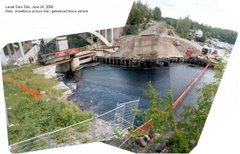
This water management plan should be developed for the Kipawa in light of the plans for the refurbished station in Temiskaming.
The Opemican Announcement
Creation
of the national park of Opémican: a key project that opens up economic
opportunities while protecting a unique ecosystem
Notre-Dame-du-Nord,
March 21, 2013 ‐ it is with a palpable joy that the MRC de
Témiscamingue and the Société de développement du Témiscamingue welcomed
this morning the official announcement of establishment of the national
park of Opémican.
The
presence of the Premier of Quebec, Ms. Pauline Marois, and the Minister
of sustainable development, the environment, wildlife and of the parks
(MDDEFP), Mr. Yves-François Blanchet, demonstrates the importance of
this announcement.
"Establishment of this national park approaches date back to 2002. After
more than 10 years of studies, briefings, meetings and consultation, we
can finally move forward with this key-project"says Arnaud Warolin,
warden of the MRC de Témiscamingue.
"This decision is important both for sustainable development and tourism development in the region. We
will now organize ourselves to maximize the economic benefits of this
project by helping private and collective enterprises so that they grasp
the new opportunities offered by this decision of the Government of
Quebec,"adds Karen Lachapelle, President of the Société de développement
du Témiscamingue.
During
these years, the MRC and the AWW worked together with the Opémican
Corporation, tourism Abitibi-Témiscamingue and the regional Conference
of elected officials to mobilize the local population to the importance
of this project. The "Opémican Generation"
campaign led to rally the forces of the environment and generate a craze
of the population around the project. We would also like to thank the team of the MDDEFP for the constance parks and the quality of their work.
taken from
http://www.mrctemiscamingue.qc.ca/upload/mrctemiscamingue/editor/asset/Op%C3%A9mican/Communiqu%C3%A9%20MRC-SDT_21mars2013%20%283%29.pdf
Wednesday, May 8, 2013
Innergex and the Kipawa
Eagle Village First Nation and Wolf Lake First Nation, are 52% owners of this Hydro Electric Project.
They are in partnership with Innergex.
They have the support of the MRC which brings economic development not only for First Nations but the county as well.
They are waiting on the Quebec Government to announce their new program allowing small hydro electric projects to be developed in Quebec.
While the Small Hydro Program has been ready it has yet to be released. On January 11th Hydro Project Strategic Meetings and Presentations were organized. January 12th in Laniel, January 13th in Temiscaming and January 14th in Kipawa / Tee Lake.
4 people from Innergex along with Chief St Denis promote the 47 Megawatts Project.
The Project proponents solicited by random phone survey feedback about the project's strategy.
contact: Health Centre (819)627-9060
davem@evfn.ca.
http://www.evfn.ca/
The project is designed to create a revenue source to the Bands.For more information:
Eagle Village First Nation
P.O. Box 756
Temiscaming, QC J0Z 3R0
Tel: (819) 627-3455
Toll Free: 1-888-229-3224
Fax: (819) 627-9428
Chief Harry St. Denis, Wolf Lake 819-627-6211
Chief Terence McBride, Timiskaming 819-629-7091 (English/Français)
Chief Madeleine Paul, Eagle Village 819-627-6884 (English/Français)
Peter Di Gangi, Algonquin Nation Secretariat 819-723-2019
The MRC has its own plans regarding hydro development.
Town of Témiscaming
20, Humphrey St., P.O. Box 730
Temiscaming (Quebec) J0Z 3R0
Mme Lyna Pine , mairesse d’Angliers
M. Luc Lalonde , maire de Béarn
M. Jean-Yves Parent , maire suppléant de Duhamel-Ouest
M. André Pâquet , maire de Fugèreville
M. Maurice Laverdière , maire de Guérin
M. Serge Larochelle , maire suppléant de Kipawa
M. Gérald Charron , maire de Laforce
M. Jacques Poudrier , maire de Latulipe-et-Gaboury
M. Daniel Barrette , maire de Laverlochère
M. Philippe Boutin , maire de Lorrainville
M. Michel Paquette , maire de Moffet
Mme Carmen Rivard , mairesse de Nédélec
et préfète suppléante de la MRCT
M. Mychel Tremblay , maire de Notre-Dame-du-Nord
M. Jocelyn Aylwin , maire de Rémigny
M. Damien Lafond , maire suppléant de St-Bruno-de-Guigues
Mme Claudine Laforge Clouâtre , mairesse de St-Édouard-de-Fabre
Mme Jacinthe Marcoux , mairesse de St-Eugène-de-Guigues
M. Bruno Boyer , maire de la Ville de Belleterre
M. Bernard Flébus , maire de la Ville de Ville-Marie
M. Yvon Gagnon, président du Comité municipal de Laniel
et représentant du territoire non organisé
M. Arnaud Warolin, préfet de la MRCT
M. Philippe Barette, maire de la Ville de Témiscaming
They are in partnership with Innergex.
They have the support of the MRC which brings economic development not only for First Nations but the county as well.
They are waiting on the Quebec Government to announce their new program allowing small hydro electric projects to be developed in Quebec.
While the Small Hydro Program has been ready it has yet to be released. On January 11th Hydro Project Strategic Meetings and Presentations were organized. January 12th in Laniel, January 13th in Temiscaming and January 14th in Kipawa / Tee Lake.
4 people from Innergex along with Chief St Denis promote the 47 Megawatts Project.
The Project proponents solicited by random phone survey feedback about the project's strategy.
contact: Health Centre (819)627-9060
davem@evfn.ca.
http://www.evfn.ca/
The project is designed to create a revenue source to the Bands.For more information:
Eagle Village First Nation
P.O. Box 756
Temiscaming, QC J0Z 3R0
Tel: (819) 627-3455
Toll Free: 1-888-229-3224
Fax: (819) 627-9428
For further information contact: www.algonquinnation.ca (Including maps and backgrounder for download)
For further information:Chief Harry St. Denis, Wolf Lake 819-627-6211
Chief Terence McBride, Timiskaming 819-629-7091 (English/Français)
Chief Madeleine Paul, Eagle Village 819-627-6884 (English/Français)
Peter Di Gangi, Algonquin Nation Secretariat 819-723-2019
The MRC has its own plans regarding hydro development.
CURRENT PROJECTS
Opémican National Park project
In the spring of 2009, the Service des parcs from the Ministère du Développement durable, de l’Environnement et des Parcs began intensive work leading to the creation of the Opémican National Park.
Opémican National Park project
In the spring of 2009, the Service des parcs from the Ministère du Développement durable, de l’Environnement et des Parcs began intensive work leading to the creation of the Opémican National Park.
Kipawa Hydroelectric Project
This project involves the construction of two hydroelectric plants along Gordon Creek with the expertise of Innergex, an independent developer and operator of renewable power generating facilities. The First Nations communities of Wolf Lake and Eagle Village will be majority owners while substantial royalties will be distributed to the Témiscamingue MRC, the municipalities of Temiscaming, Kipawa and Laniel.
This hydroelectric complex was built around 1917 by the
International paper company for its own needs, it includes
three (3) buildings (the dam, the relay and the building housing the turbines) connected
between them through ducts that traverse the city over a distance of approximately
1 mile.
This project, which consists of two (2) power plants along the Creek
Gordon, adopts the principle of the former the exploited Gatineau Power plant
at Témiscaming until 1969.
With a total installed capacity of 42 MW, the Kipawa project will produce
220 Gigawatt-hours of electricity annually, which in addition to secure
regional electricity supply, generate direct revenues
Eagle Village First Nation and Wolf Lake First Nation, which will be
owners at 52% as well as substantial for economic benefits
the region.
20, Humphrey St., P.O. Box 730
Temiscaming (Quebec) J0Z 3R0
Note from MDDEFP
regarding Opemican National Park project.
“as you requested in your brief, both McKenzie Island and Pointe du Rocher au Corbeau peninsula sectors will be excluded from the Parc National d’Opemican project and that we are studying the possibility of assigning them the status of protected biodiversity reserve so that they can be withdrawn from the commercial exploitation of resources”. In addition they also stated that “The final decision to create the Parc National d’Opemican has not yet been made”.
but on March 21st, 2013 Premiere Pauline Marois an-nounced in Notre Dame du Nord that the Opemican Park Project was a go. McKenzie Island and Corbeau Peninsula will be removed from the boundaries.
So the Algonquin Chiefs will be sending a joint letter to Premier Marois confirming their shared position on the creation of Opemican Park, which is the park can’t be legally created without an agreement with the Algonquin First Nations of Wolf Lake and Eagle Village since the proposed Park site is located within the territory where the Algonquins of Wolf Lake and Eagle Village assert Aboriginal Rights and Title.
source:http://www.evfn.ca/Newsletters.html
MRC Temiskaming
http://www.mrctemiscamingue.qc.ca
21, rue Notre-Dame-de-Lourdes, Bureau 209
Ville-Marie (Québec) J9V 1X8
Téléphone : 819 629-2829
Télécopieur : 819 629-3472
http://www.mrctemiscamingue.qc.ca
21, rue Notre-Dame-de-Lourdes, Bureau 209
Ville-Marie (Québec) J9V 1X8
Téléphone : 819 629-2829
Télécopieur : 819 629-3472
Mme Lyna Pine , mairesse d’Angliers
M. Luc Lalonde , maire de Béarn
M. Jean-Yves Parent , maire suppléant de Duhamel-Ouest
M. André Pâquet , maire de Fugèreville
M. Maurice Laverdière , maire de Guérin
M. Serge Larochelle , maire suppléant de Kipawa
M. Gérald Charron , maire de Laforce
M. Jacques Poudrier , maire de Latulipe-et-Gaboury
M. Daniel Barrette , maire de Laverlochère
M. Philippe Boutin , maire de Lorrainville
M. Michel Paquette , maire de Moffet
Mme Carmen Rivard , mairesse de Nédélec
et préfète suppléante de la MRCT
M. Mychel Tremblay , maire de Notre-Dame-du-Nord
M. Jocelyn Aylwin , maire de Rémigny
M. Damien Lafond , maire suppléant de St-Bruno-de-Guigues
Mme Claudine Laforge Clouâtre , mairesse de St-Édouard-de-Fabre
Mme Jacinthe Marcoux , mairesse de St-Eugène-de-Guigues
M. Bruno Boyer , maire de la Ville de Belleterre
M. Bernard Flébus , maire de la Ville de Ville-Marie
M. Yvon Gagnon, président du Comité municipal de Laniel
et représentant du territoire non organisé
M. Arnaud Warolin, préfet de la MRCT
M. Philippe Barette, maire de la Ville de Témiscaming
Subscribe to:
Posts (Atom)
Useful Links
- Mount Gox - Bitcoin exchange
- Reggie Middleton's Rapier Analysis
- Ontario Rivers Alliance
- Geodesic Dome Construction
- Canadian Disaster Preparedness
- Globe and Mail
- Chris' The Weekly Telegram
- Michael Rupert of CollapseNet
- Max Keiser
- Nicole Foss Blog - the automatic earth
- Peak Moment Discussions
- Scotia Mocatta Bullion Store
- Dimitry Orlov - Peak Moment Discussions
- Jims's ISFCR Blog
- Jenny Right Side Blog
- Scott Sorensen
Alternative Energy Sites I like
Whitewater Ontario - Mission Statement
It is Whitewater Ontario’s mission to support the whitewater paddling community through the promotion, development and growth of the sport in its various disciplines.
We accomplish this through the development of events, resources, clubs, and programs for personal and athletic development, regardless of skill level or focus, to ensure a high standard of safety and competency;
We advocate safe and environmentally responsible access and use of Ontario’s rivers.
Whitewater Ontario is the sport governing body in the province, and represents provincial interests within the national body Whitewater Canada and the Canadian Canoe Association
http://www.whitewaterontario.ca/page/mission.asp
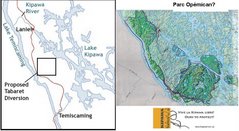
Kipawa, Tabaret, and Opemican
If Hydro Quebec is not actively pursuing Tabaret what is that bite out of Opemican for?
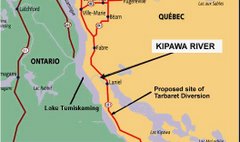
Where is the Kipawa
Kipawa flows into lake Temiskamingue, running from Kipawa Lake, under hwy 101 in Quebec
Tabaret is a Bad Idea
About the Kipawa
The best thing paddlers can do to help the cause of the Kipawa:
1. attend the rally and bring others including non paddlers to attend and buy beer and have fun
2. write your MP /MNA and raise the issue and post your objections -1 letter = 200 who didn't write
3. Write Thierry Vandal the CEO of Hydro Quebec strongly opposing the 132 MW standard decrying the use of "diversion" as the most environmentally inappropriate method of power production
4. Write Jean Charest, Premier of Quebec protesting that either the algonquin or the tabaret project will eliminate all other values on the Kipawa River by turning it into a dry gulch.
5. See if you can get other allied groups interested by showing your own interest, ie the Sierra Defense Fund, Earthwild, MEC, and so on.
6. Demand further consultation
7. Currently we are at the point where we need to sway public opinion and raise awareness.
However, if all else fails, don't get mad, simply disrupt, foment, and protest . The Monkey Wrench Gang.
Have you read Edward Abbey?
Important Addresses
CEO,Hydro Québec, 75 boul René Levesque, Montreal, P.Q., H2Z 1A4Caille.andre@hydro.qc.ca
The best thing paddlers can do to help the cause of the Kipawa:
1. attend the rally and bring others including non paddlers to attend and buy beer and have fun
2. write your MP /MNA and raise the issue and post your objections -1 letter = 200 who didn't write
3. Write Thierry Vandal the CEO of Hydro Quebec strongly opposing the 132 MW standard decrying the use of "diversion" as the most environmentally inappropriate method of power production
4. Write Jean Charest, Premier of Quebec protesting that either the algonquin or the tabaret project will eliminate all other values on the Kipawa River by turning it into a dry gulch.
5. See if you can get other allied groups interested by showing your own interest, ie the Sierra Defense Fund, Earthwild, MEC, and so on.
6. Demand further consultation
7. Currently we are at the point where we need to sway public opinion and raise awareness.
However, if all else fails, don't get mad, simply disrupt, foment, and protest . The Monkey Wrench Gang.
Have you read Edward Abbey?
Important Addresses
CEO,Hydro Québec, 75 boul René Levesque, Montreal, P.Q., H2Z 1A4Caille.andre@hydro.qc.ca
Tabaret is a Bad Idea (Part Two)
Les Amis de la Riviere Kipawa is poised to use an application to the Federal Court to issue a Writ of Mandamus to ensure the Minster does what he is supposed to do, protect the public's right to navigate the water control structure at Laniel, Quebec using the Navigable Waters Protection Act. (see http://www.kipawariver.ca/)
In the now gutted Navigable Waters Protection Act lay the means by which the Minister of Transport could keep the public right of passage down our great Canadian Heritage, our rivers and streams which are threatened especially by resource corporations and power brokers such as Hydro Quebec.
These powerful entities continue to petition that 'this' river or 'that' stream is not navigable and therefore not protectable.
I don't say that dams and bridges should not be built, only that if they are, historical navigation rights should be considered and preserved by making reasonable accommodations for recreational boaters.
It is the Minister of Transport, in exercising the right to allow or disallow work on or over a navigable waterway is what keeps boats and recreational boaters plying our waterways.
To many recent cases launched in the Federal Court concerning the Navigable Waters Protection Act, most recently the case of the Humber Environment Group of Cornerbrook Newfoundland versus the Cornerbrook Pulp and Paper Company indicates that the important oversight is not being faithfully performed. Have we really come to the point now where we must say "such and such a stream is one foot deep, possessing so many cubic feet per second flow and so on?" The answer to this is... YES!
The honourable Mr. Justice John A. O'Keefe, ruled that it had not been shown that the river was navigable. How convenient was that to the Minister? But either the Minister of Transport acts to protect our rivers and streams as a public right or he does not and that means rivers and streams currently enjoyed by kayakers and canoists.
Enough of the cheating, and double-talk. Canadians! our rivers and streams are our own, lets urge the Minister of Transport and the our government to protect them.
Peter Karwacki
In the now gutted Navigable Waters Protection Act lay the means by which the Minister of Transport could keep the public right of passage down our great Canadian Heritage, our rivers and streams which are threatened especially by resource corporations and power brokers such as Hydro Quebec.
These powerful entities continue to petition that 'this' river or 'that' stream is not navigable and therefore not protectable.
I don't say that dams and bridges should not be built, only that if they are, historical navigation rights should be considered and preserved by making reasonable accommodations for recreational boaters.
It is the Minister of Transport, in exercising the right to allow or disallow work on or over a navigable waterway is what keeps boats and recreational boaters plying our waterways.
To many recent cases launched in the Federal Court concerning the Navigable Waters Protection Act, most recently the case of the Humber Environment Group of Cornerbrook Newfoundland versus the Cornerbrook Pulp and Paper Company indicates that the important oversight is not being faithfully performed. Have we really come to the point now where we must say "such and such a stream is one foot deep, possessing so many cubic feet per second flow and so on?" The answer to this is... YES!
The honourable Mr. Justice John A. O'Keefe, ruled that it had not been shown that the river was navigable. How convenient was that to the Minister? But either the Minister of Transport acts to protect our rivers and streams as a public right or he does not and that means rivers and streams currently enjoyed by kayakers and canoists.
Enough of the cheating, and double-talk. Canadians! our rivers and streams are our own, lets urge the Minister of Transport and the our government to protect them.
Peter Karwacki
Tabaret is a Bad Idea (Part Three)
10 Reasons WhyTabaret is a Bad Idea1) Tabaret is too big. The station is designed to useevery drop of water available in the Kipawawatershed, but will run at only 44 percent capacity.We believe the Tabaret station is designed to usewater diverted from the Dumoine River into theKipawa watershed in the future.
2) The Tabaret project will eliminate the aquaticecosystem of the Kipawa River.The Tabaret project plan involves the diversion of a16-km section of the Kipawa River from its naturalstreambed into a new man-made outflow from LakeKipawa.


3) Tabaret will leave a large industrial footprint on thelandscape that will impact existing tourismoperations and eliminate future tourism potential.
4) The Tabaret project is an aggressive single-purposedevelopment, designed to maximize powergeneration at the expense of all other uses.
5) River-diversion, such as the Tabaret project, takinglarge amounts of water out of a river’s naturalstreambed and moving it to another place, is verydestructive to the natural environment.
6) The Kipawa River has been designated a protectedgreenspace in the region with severe limitations ondevelopment. This designation recognizes theecological, historical and natural heritage value ofthe river and the importance of protecting it.Tabaret will eliminate that value.
7) If necessary, there are other, smarter and morereasonable options for producing hydro power onthe Kipawa watershed. It is possible to build a lowimpactgenerating station on the Kipawa river, andmanage it as a “run-of-the-river” station, makinguse of natural flows while maintaining other values,with minimal impact on the environment.
8) The Kipawa watershed is a rich natural resource forthe Temiscaming Region, resonably close to largeurban areas, with huge untapped potential fortourism and recreation development in the future.Tabaret will severely reduce this potential.
9) Tabaret provides zero long-term economic benefitfor the region through employment. The plan is forthe station to be completely automated andremotely operated.
10) The Kipawa River is 12,000 years old. The riverwas here thousands of years before any peoplecame to the region. The Tabaret project will change all that.
Problems on a local River?
- There is more to do as well but you have to do your research and above all, don't give up.
- IN the meantime prepared a document itemizing the history of navigation of this spot and its recreational value. Use the Kipawa river history of navigation as a guide: see www.kipawariver.ca
- Under the Ministry of Environment guidelines you have a set period of time to petition the change under the environmental bill of rights, you may have limited time to take this action. But it involves going to court for a judicial review of the decision.
- 4. contact the ministry of natural resources officials and do the same thing.
- 3. contact the ministry of the environment and determine if they approved the project
- 2. determine if the dam was a legal dam, approved under the navigable waters protection act.
- 1. research the decision and timing of it to determine if an environmental assessment was done.
T-Shirts Area: These are available now!
Send $25 and a stamped self addressed envelop for the Tshirt, and for the bumper sticker, a stamped and self addressed envelope with $5.00 for the bumper sticker to Les Amis de la rivière Kipawa, 80 Ontario St., Ottawa, Ontario, K1K 1K9 or click the link To purchase a Les Amis "T" contact Doug with the following information: Number of shirts:Sizes: Ship to Address: Method of Payment: cash, cheque and paypal, Shipto address: