Working Hard to Safeguard Paddling Assets for All Canadians

All about Whitewater

All about Whitewater
A Blog about River Preservation and the need to protect our free flowing whitewater resources

Friday, August 3, 2007

Inflatables on the Ottawa?


Clearly: inflatables are not allowed.


Private Inflatables on the Ottawa River: is this good or bad


Get involved in access issues by networking with other interested and effectives parties.

Question: is there a need to continue to work with Ottawa River rafting companies to secure access for private inflatables? Controlled access and egress seems to limit competition.

OWL provides private kayak access to the river at McKoys. This is an invaluable kayaker resource that should be preserved and protected.
Wilderness Tours has recently hosted the World Freestyle championships and provides kayak take out at "Black's" another invaluable resource. Thanks to farmer Black and Joe Kowalski.

On the other hand, private inflatables (Shredders, duckies Etc.) are not currently allowed at kayak/C1 access in favour of the LaPasse put-in
and take out on some public access above Portage.

Private companies have the right to decide who uses their property and facilities, including deciding how cars are parked on their
access roads and what kind of craft is going in and out.

Some may see the limiting of private inflatables use of the river by controlling access as a very serious access issue other may care less.

Private rafters are legitimate river users and that may consider a ban on private rafts as unreasonable restriction flying in the face of access responsibilities of commercial riverside landowners : which at present are moral and ethical rather than legal or practical.

But the whitewater section of the Ottawa river is not a park. Its banks are under municipal and or private jurisdiction and organization. There is no responsibility to provide access for all.

True public access to the Ottawa river would have to be provided by a level of government acting in the public interest. Until that step is taken controlled access and egress and the threat of blocked access will
allow operators to pick and choose who can run a river that is being and essential create a situation where the river itself has become a privately owned resource.

Whitewater Ontario is very interested in all aspects of river development which may impinge upon the traditional rights of whitewater recreational and commercial paddlers. We wish to establish a dialogue with key Ministry (MNR) Contacts and take steps to ensure that Whitewater Ontario and/or its affiliates will be considered as potential intervenors, committee members and stakeholders of record for the development of new water management plans in the province. As whitewater paddlers, our interests often overlap with the interests of hydro-power development. But we understand that is the reality of resource use today, and that the best development is a development that takes into consideration all of the values of a resource. Whitewater Ontario would like to be directly notified, via email dispatches, of pending river development projects that may impinge upon traditional whitewater paddling activities including bridges, or dams, which may curtail traditional navigation as described under the Navigable Waters Protection Act and any shoreside development which may curtail traditional access and portage rights. To this end, Whitewater Ontario is working to beome a stakeholder of record on all new site applications. We believe the number of new site projects that paddlers will have concerns about will be small but we will be able to provide assistance in the public consultation, environmental assessment and impact assessment phases.

Outside of Ontario we are dismayed by the case the of a Quebec river, the Kipawa, which is currently being argued in federal court, where a dam owner completely ignored the navigation rights of paddlers in contravention of the Navigable Waters Protection Act.

Your assistance would be appreciated in achieving these objectives by becoming more involved with Whitewater Ontario as an active member, working on committees, projects, or as a member of the executive decision making group.

For ongoing information be sure to contact our office administrator, Donna Boadway, or me as the president of Whitewater Ontario. I have a personal blog, whitewaterontario.blogspot.com and there is the official site of Whitewater Ontario: www.whitewaterontario.ca

Thanks again for becoming a member
_________________
Working hard to safeguard paddling assets for all Canadians


Pete

Monday, July 23, 2007

Has Success Spoiled the Ottawa River?


On one hand we want the public to understand the economic value of whitewater. On the other, we see that overuse of any natural resource can be a problem.

At the very least paddlers can approach the sport with caution, paddling safely and managing use in such a way that is courteous and sustainable.

The question remains: how to deal with "yahoos" and "dorks" on the river.

If you get involved and try to help, you may become exposed to liabilty. If you ignore the situation (if there are children) and something serious happens you live with guilt.

If you see something that looks like it's leading to a real accident, speak up.
If rebuffed as being a busy body or worry wart then respond with something like, " I guess someone like me who spends hundreds of days playing in whitewater wouldn't really know anything at all about that" and let the pieces fall where they may.

Not every one doing something 'apparently stupid' is actually deserving of the outcome. Say something like, "have you done this before?"

Crashing, surf?, dangerous currents? rocky shoreline?

No, this is not Minden, its the coast of california where the state has made access easy by improved and unimproved trails. In that state there is no liabiity to anybody for permitting access to the coastline.

Here in Canada we must put up a six foot high fence around pools to dissuade children because a pool is considered an attractive nuisance.

TO summarize:

To the apparently adult participant...

1. ask "have you done this before"

2. accept that you haven't seen it all or heard it all - if rebuked

3. help pick up the pieces as a good samaritan after the fact if you can


I'm reminded of the Kipawa Case where safety was used as the concern about running the laniel dam sluice, while ATV's were facilitated in running the dam's deck.

We don't think its a good idea to run mopeds on the QEW but to my knowledge its perfectly legal to do so.

I think a track record of safety is a good indicator but yahoos and bunyaulks abound.

If children are the concern: call the Children's Aid Society! or the Police as they are the only parties embued with the right to intervene.


Regarding Kayak/Raft collisions


The difference between a raft running the river and "running over" a guy who has jumped on the wave in front of the raft - and the next case, the raft guide purposely mowing over kayaks in an eddy or jumping on the wave from the eddy running them over is significant.

For example, If you were driving down the road and someone on a skateboard jumped off the sidewalk in front of your vehicle and you hit them you probably would not be charged. ...However if you were chasing the skateboarder through a parking lot in your vehicle and hit him, charges would likely be pending.

12 200lb gorbies plus a raft and guide weigh close to 3000lb. Piloting a raft in such a way as to intentionally run over people is a dangerous and unsustainable proposition.

Thursday, July 5, 2007

ALEX for 10 pts...what is the Canadian Environmental Network

What's all this?

My first interest is to become more knowledgeable and active concerning the CEN.
This is a rather large black hole at present.

Frankly I'm a bit surprised at how my group, LARK, could have advanced so far in its mission to preserve the rights of Canadians to navigate their lakes, rivers and streams unfettered by the capricious actions of government and at the same time not been notified or even obliquely affected by the CEN!!

But maybe this is a good thing?

As I have said, I'm an activist. I write letters, attend meetings, deliver papers, forment, and where certain bureaucrates are concerned, possibly torment. Still, I'd rather work from the inside out than from the outside in. Currently it is no fun at all being an environmentalist.

The Canadian Environmental Network (RCEN - notice RCEN - right away a problem since the name is CEN logically but here we see the consistent inclusion of the french "R")

Environmental Non-Government Organizations can become RCEN members by joining their regional affiliate environmental network, which would be either the Ontario Environment Network (OEN) for Whitewater Ontario or the Réseau affilié des associations environnementales du Québec (RAAEQ) where LARK is located.

The RCEN is not a government agency, it is a non-government, non-advocacy, non-partisan network, with over 800 member groups across Canada.

If you have never heard of them, it’s probably because apparently RCEN/CEN doesn't take positions on issues.

Their role is to facilitate communication and build capacity among our member groups, and to get them involved in consultations with the federal government on environmental policy issues.

CEN members attend these consultations on behalf of their own organizations, and while they do consult with the broader RCEN/CEN membership before and afterwards in order to gather input and disseminate information, they do not represent the RCEN/CEN at external meetings.

One of their key processes is the delegate selection process. The RCEN/CEN puts out calls for delegates for over 100 consultations annually; and have a well-established delegate selection process that is respected by environmental groups and government alike for being bilingual, democratic and transparent.

See their website at http://www.cen-rce.org/eng/consultations/delegate_selection.html

Delegates must be current members of the RCEN/CEN in good standing.

Once an RCEN member, sign up for CEN weekly e-bulletins (also on-line at http://www.cen-rce.org/eng/bulletin.html ), with up to date information on RCEN/CEN member activities and RCEN/CEN Calls for delegates.

Members join a National Caucus and get connected with groups across Canada working on similar issues.

see their website at www.cen-rce.org .


Joining the RCEN will also allow you to join one of their ten National Caucuses that collaborate on various environmental issues, including the Water, Fisheries and Oceans Caucus.


LARK is based on Quebec with Ontario members: nothing is neat and tidy. I noticed it costs $40 to be a member in Ontario and $20 to be a member in Quebec, Plus, the form for membership is available on the Quebec site but nothing no doc no pdf is actively available on the Ontario site.


For more information, visit the RCEN/CEN website. You can find the contact info for our regional affiliate networks, as well as information on our National Caucuses.

Leela Ramachandran

National Caucus Coordinator/Coordonnatrice des caucus nationaux

Canadian Environmental Network

Réseau canadien de l'environnement

300-945 Wellington West

Ottawa, ON K1Y 2X5

Tel: 613-728-9810 ext. 223

Fax: 613-728-2963

Leela@cen-rce.org

www.cen-rce.org
1. Since the 2006 Annual report is unavailable, would it also be possible to have the names and contact information for the current Board of Directors, the names of their respective ENG's indicating the name of the current Chairperson please?

The list of Board members is the following:
BoD Chair 2006: STEVE RISON , Citizen Advisory for Environmental Research, Chair for 1 year
Vice Chair 2006: DOUG BADGER, High Prairie Regional Environmental Action Committee, Aboriginal Representative 2004
Treasurer 2006: ANDREA WAYWANKO, Sierra Club – Prairie Chapter, Regional Affiliate Representative 2005
Secretary 2006: MICHAEL SIMPSON, One Sky, Member at Large Representative 2004
GABRIELLE KRETZCHMAR , New Brunswick Partners in Agriculture, National Caucus Representative 2006
OLIVIER KOLMEL , Conseil régional de l’environnement-Montréal, Francophone Representative 2006
YUJING GU , Saskatchewan Environmental Society, Youth Representative 2006
DENISE HAMMEL , First Nation Technical Services Advisory Group, Member at Large Representative 2006
PHILIPPE BOURKE , Regroupement national des conseils régionaux en environnement, Quebec Affiliate Representative 2006
More information about our governance is available at http://www.cen-rce.org/eng/governance.html.


2. Back in 2004, what led to the disaffiliation of the RQGE?

I wasn't involved with the disaffiliation of the RQGE, but I understand they had a different vision of networking from the RCEN's. The RCEN focuses on networking with ENGOs, even when ENGO members have opposite views on various topics. The RCEN serves as a discussion forum to facilitate communications among ENGOs, and with the Government.

The RAAEQ is now the RCEN's Quebec Affiliate. They currently have more than 70 members.


3. What are your past experiences with petitions to the auditor general's office?

Because we are a non-advocacy, non-partisan organization, the RCEN does not send petitions.
RCEN members do send petitions from time to time, and the RCEN may provide communication support for strategizing purposes, but the RCEN does not send petitions.


4. Would it be possible to include the recreational use of naturally occuring whitewater as an item on the list of Water issues?

Once you become a member of a Provincial Affiliate, you may decide to join regional caucuses/activities and to join a national caucus.
To join a national caucus, a member should contact the appropriate National Caucus Coordinator. The Caucus Steering Committee is made aware of new caucus members.
Once you become a member of the Water caucus, you decide with the rest of the group which issues to discuss. National Caucus Coordinators don't decide which issues will be dealt with.
They can sometimes make recommendations, but the caucus has the final say.


5. Concering the navel gazing done by the BCEN and Quebec (reports such as Sandra Thompson report concerning the BCEN) would you say that these findings are more or less universal: from your point of view: as it seems to me they are.

All Provincial Affiliates have had ups and downs throughout the years, because of variations in regional topics, funding availability, provincial governments, etc. But currently, both the BCEN and the RAAEQ work well with the rest of the network.


6. About the OEN:

To contact the OEN, you should talk to Phillip Penna by email at oen@oen.ca or by phone at (705) 840-2888.
The OEN membership subscription form is available at http://www.oen.ca/membersinfo.html.

Resources vary from province to province, depending on provincial funding, foundation resources, donations, and other local sources of funding.
In the past 15 years, I believe the RCEN's central office received more funding than its affiliates.


7. Annual report and funding:

I found the attached past annual reports on our website at http://www.cen-rce.org/eng/publications/index.html. Two of them are password protected. I'm not sure why. I'll try to get the passwords and get back to you.

Our funding comes from coordination contracts with various Government of Canada Departments. Most of our work takes place with Environment Canada.


_________________
Working hard to safeguard paddling assets for all Canadians

Wednesday, July 4, 2007

LES AMIS MEDIA ITEMS

From the Director of River Preservation Activities

On the judicial review:

- We are asking the court to review PW and Transport Canada's failure to protect navigation rights.

- There are two issues we are asking the court to look at, one is navigation rights under the NWPA and the other is the federal government's responsibility to consider significant environmental impacts of their projects and conduct meaningful public consultation on those impacts.


On the cancellation of the rally:

- In May we were trying to arrange a meeting with PW to talk about our plans for the 2007 rally. PW refused to meet with us.

- While we were trying to talk to PW they published an ad in local newspapers saying that they were going to deny access to the entire top section of the river during the festival. That is the way they chose to talk to us by putting an ad in the newspaper, and they planned to eliminate our navigation rights, not just at Laniel but on the entire top section of the river.

- We contacted PW and they told us the ad was placed in error, but how do you make an error like that? We then asked them to confirm that they would make water available and they refused to do that. In fact they are now denying that they have provided water for us for the last 20 years.

- We are a non-profit group of volunteers trying to host a community festival that benefits tourism. One of the reasons people come to this festival from all over eastern Canada and parts of the U.S. is because we have had a water release for the past 20 years. If you take away that water release the rally is finished. We can't host it. We can't ask tourists to spend their money and come all the way up here if PW is not going to make water available.

- We canceled the rally because we couldn't trust PW.

- We were able to cancel the rally, but one of the rafting companies that comes on that weekend already had over 100 people booked and paid to go rafting, they couldn't cancel their trips. The rafting company explained to PW that they were running trips that weekend and asked that water levels be maintained...and this is what PW did...SEE LANIEL DAM WATER LEVEL CHART. This what PW did on that weekend. They purposefully closed the dam on Friday and then opened again on Monday. They ruined the rafting company's trip. And they did it on purpose.

- So why is PW doing this? Why are they denying that they've given us a water release for the past 20 years? Why are they acting against non-profit volunteer group? Why are they purposefully ruining a tourism operation in the region?

- We think it is to punish us because we have a case against them in federal court. Governments are not supposed punish people for taking action to protect their rights, rights that are guaranteed under law. That's not supposed to happen in a democracy.

ON HYDRO DEVELOPMENT:

- There are two hydro project proposals on the table...Tabaret and the Algoqnuin Project.

- The problem is that BOTH of these projects will divert almost all of the water from the Kipawa River below Laniel.

- We are not against Hydro development. We are against BAD hydro development.

- Turning a 10,000 year old river into a little trickle of water and eliminating the future tourism potential of that river, to produce hydro power is BAD hydro development.

- Yes we have to look for ways to generate electricity. Yes hydro is sometimes a very good option in some places. Yes hydro could be developed on the Kipawa Watershed, and even on the Kipawa River.

- But that hydro development needs to leave room for other economic opportunities like tourism. You don't have to destroy the Kipawa River to produce hydro on this watershed.

- One option is to build a small hydro station at Laniel. There is enough drop there. There is enough water, and if you generate hydro at Laniel you save the Kipawa River because the water stays in the river. And you invest in tourism because people will still come here to paddle the river.

- Making a choice on hydro development doesn't mean you have to throw other values away. You use smart development that makes room for other values and doesn't eliminate future economic potential.

- We don't have the right to take this river away from our children and our grand-children. We need to protect it so that they will have choices to make in their future.

Wednesday, June 27, 2007

Ropes on and across the Gull River


Whitewater enthusiasts appreciate and respect the value of rescue practices. Much of what is known about swift water rescue today has been gathered by commercial whitewater organizations based in paddling pursuits. We need to support learning process and the same goals with respect to safety on the water.

Regarding your ropes set up crossing the river:

From the point of view of paddlers who travel long distances to use the upper section of the river, particularly the hole known to river users as Earl’s, it is the re-circulation over which fixed rescue ropes usually intersect rendering that section of river un-useable for a period of time.

Whitewater Ontario urges groups and individuals to discontinue the practice of roping across the entire river in a way that is not only obstructive but potentially dangerous to paddlers. There are issues beyond the inconvenience of a few paddlers. The set up may constitute a safety hazard if left unattended. There are laws to consider here and the wishes of property owners of the riverbanks. Whitewater Ontario is the property owner of the southern bank. We have found that the Township has similar concerns as Whitewater Ontario and they are the owners of the northern bank. The Township values the contribution of thousands of paddling visitors in this community each summer.

Consider that there must be an alternative location or technique that accomplishes the same thing. There must be a way in which you can reach your training goals without taking total control of this busy section of river.

On the River Program


For years we have recognized the immense value of having non paddlers seeing the Kipawa First hand by walking the trail or rafting.

Esprit Rafting has done an great service in introducing the non- paddler and helping to put a public face to the river, especially to local population from Temiskaming.

This is what is known as an "on the river program" for river preservation and is a strategic method of broadening public support.

What is required now is to build on this public outrage. We have namedthe source of the problem now we must set upon him a veritable nest of hornets. Only public spotlight, telephone calls, letters that demand a response, appeals to overlords and political masters, appeals to the real opposition in this country> the MEDIA, anything anyone can do to help would be appreciated.

In the meantime, we have a new legal challenge, which is what these socalled managers have arranged, tort action for loss of business. This was a disenting opinion at the Supreme Court in the OldMan River case.

Make 'em pay - but with our own money sadly.

...And curse the day we came to appreciate lawyers pleading both sides of an issue with equal aplomb.

Canadian Rivers

Canadian Rivers
I speak for river users too!

The Queen is not amused!

The Queen is not amused!
http://www.ispeakforcanadianrivers.ca/

The Damned Dam - 2005 -

The Damned Dam - 2005 -
22nd Annual Kipaw Rally has modest turnout. - 23rd does better

The Ashlu river: it could happen to you

The Ashlu river: it could happen to you

Whitewater Ontario

Whitewater Ontario
Working Hard to Protect Canada's Paddling Resources

Whitewater Ontario - Mission Statement

It is Whitewater Ontario’s mission to support the whitewater paddling community through the promotion, development and growth of the sport in its various disciplines. We accomplish this through the development of events, resources, clubs, and programs for personal and athletic development, regardless of skill level or focus, to ensure a high standard of safety and competency; We advocate safe and environmentally responsible access and use of Ontario’s rivers. Whitewater Ontario is the sport governing body in the province, and represents provincial interests within the national body Whitewater Canada and the Canadian Canoe Association http://www.whitewaterontario.ca/page/mission.asp

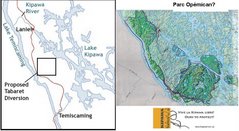
Kipawa, Tabaret, and Opemican

Kipawa, Tabaret, and Opemican
If Hydro Quebec is not actively pursuing Tabaret what is that bite out of Opemican for?

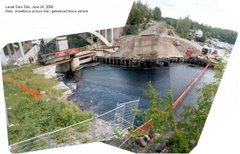
Kipawa Dam: After

Kipawa Dam: After
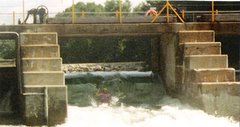
Laniel Dam at 2006 Rally

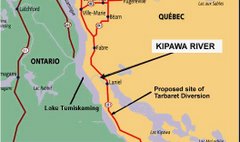
Where is the Kipawa

Where is the Kipawa
Kipawa flows into lake Temiskamingue, running from Kipawa Lake, under hwy 101 in Quebec

Kipawa Dam

Kipawa Dam
laniel dam at 2004 River Rally

Tabaret is a Bad Idea

About the Kipawa


The best thing paddlers can do to help the cause of the Kipawa:

1. attend the rally and bring others including non paddlers to attend and buy beer and have fun

2. write your MP /MNA and raise the issue and post your objections -1 letter = 200 who didn't write

3. Write Thierry Vandal the CEO of Hydro Quebec strongly opposing the 132 MW standard decrying the use of "diversion" as the most environmentally inappropriate method of power production

4. Write Jean Charest, Premier of Quebec protesting that either the algonquin or the tabaret project will eliminate all other values on the Kipawa River by turning it into a dry gulch.

5. See if you can get other allied groups interested by showing your own interest, ie the Sierra Defense Fund, Earthwild, MEC, and so on.

6. Demand further consultation

7. Currently we are at the point where we need to sway public opinion and raise awareness.

However, if all else fails, don't get mad, simply disrupt, foment, and protest . The Monkey Wrench Gang.

Have you read Edward Abbey?

Important Addresses
CEO,Hydro Québec, 75 boul René Levesque, Montreal, P.Q., H2Z 1A4Caille.andre@hydro.qc.ca


Tabaret is a Bad Idea (Part Two)

Les Amis de la Riviere Kipawa is poised to use an application to the Federal Court to issue a Writ of Mandamus to ensure the Minster does what he is supposed to do, protect the public's right to navigate the water control structure at Laniel, Quebec using the Navigable Waters Protection Act. (see http://www.kipawariver.ca/)

In the now gutted Navigable Waters Protection Act lay the means by which the Minister of Transport could keep the public right of passage down our great Canadian Heritage, our rivers and streams which are threatened especially by resource corporations and power brokers such as Hydro Quebec.

These powerful entities continue to petition that 'this' river or 'that' stream is not navigable and therefore not protectable.
I don't say that dams and bridges should not be built, only that if they are, historical navigation rights should be considered and preserved by making reasonable accommodations for recreational boaters.

It is the Minister of Transport, in exercising the right to allow or disallow work on or over a navigable waterway is what keeps boats and recreational boaters plying our waterways.

To many recent cases launched in the Federal Court concerning the Navigable Waters Protection Act, most recently the case of the Humber Environment Group of Cornerbrook Newfoundland versus the Cornerbrook Pulp and Paper Company indicates that the important oversight is not being faithfully performed. Have we really come to the point now where we must say "such and such a stream is one foot deep, possessing so many cubic feet per second flow and so on?" The answer to this is... YES!

The honourable Mr. Justice John A. O'Keefe, ruled that it had not been shown that the river was navigable. How convenient was that to the Minister? But either the Minister of Transport acts to protect our rivers and streams as a public right or he does not and that means rivers and streams currently enjoyed by kayakers and canoists.

Enough of the cheating, and double-talk. Canadians! our rivers and streams are our own, lets urge the Minister of Transport and the our government to protect them.

Peter Karwacki

Tabaret is a Bad Idea (Part Three)

10 Reasons WhyTabaret is a Bad Idea1) Tabaret is too big. The station is designed to useevery drop of water available in the Kipawawatershed, but will run at only 44 percent capacity.We believe the Tabaret station is designed to usewater diverted from the Dumoine River into theKipawa watershed in the future. 2) The Tabaret project will eliminate the aquaticecosystem of the Kipawa River.The Tabaret project plan involves the diversion of a16-km section of the Kipawa River from its naturalstreambed into a new man-made outflow from LakeKipawa. 3) Tabaret will leave a large industrial footprint on thelandscape that will impact existing tourismoperations and eliminate future tourism potential. 4) The Tabaret project is an aggressive single-purposedevelopment, designed to maximize powergeneration at the expense of all other uses. 5) River-diversion, such as the Tabaret project, takinglarge amounts of water out of a river’s naturalstreambed and moving it to another place, is verydestructive to the natural environment. 6) The Kipawa River has been designated a protectedgreenspace in the region with severe limitations ondevelopment. This designation recognizes theecological, historical and natural heritage value ofthe river and the importance of protecting it.Tabaret will eliminate that value. 7) If necessary, there are other, smarter and morereasonable options for producing hydro power onthe Kipawa watershed. It is possible to build a lowimpactgenerating station on the Kipawa river, andmanage it as a “run-of-the-river” station, makinguse of natural flows while maintaining other values,with minimal impact on the environment. 8) The Kipawa watershed is a rich natural resource forthe Temiscaming Region, resonably close to largeurban areas, with huge untapped potential fortourism and recreation development in the future.Tabaret will severely reduce this potential. 9) Tabaret provides zero long-term economic benefitfor the region through employment. The plan is forthe station to be completely automated andremotely operated. 10) The Kipawa River is 12,000 years old. The riverwas here thousands of years before any peoplecame to the region. The Tabaret project will change all that.

Problems on a local River?

  • There is more to do as well but you have to do your research and above all, don't give up.
  • IN the meantime prepared a document itemizing the history of navigation of this spot and its recreational value. Use the Kipawa river history of navigation as a guide: see www.kipawariver.ca
  • Under the Ministry of Environment guidelines you have a set period of time to petition the change under the environmental bill of rights, you may have limited time to take this action. But it involves going to court for a judicial review of the decision.
  • 4. contact the ministry of natural resources officials and do the same thing.
  • 3. contact the ministry of the environment and determine if they approved the project
  • 2. determine if the dam was a legal dam, approved under the navigable waters protection act.
  • 1. research the decision and timing of it to determine if an environmental assessment was done.

Minden Ontario

Minden Ontario
Gull River Water control at Horseshoe lake

A History of Navigation on the Kipawa River

Prior to the environmental assessment there was no signage at the Laniel Dam

T-Shirts Area: These are available now!

T-Shirts Area: These are available now!
Send $25 and a stamped self addressed envelop for the Tshirt, and for the bumper sticker, a stamped and self addressed envelope with $5.00 for the bumper sticker to Les Amis de la rivière Kipawa, 80 Ontario St., Ottawa, Ontario, K1K 1K9 or click the link To purchase a Les Amis "T" contact Doug with the following information: Number of shirts:Sizes: Ship to Address: Method of Payment: cash, cheque and paypal, Shipto address:

Bumper Stickers Now Available

Bumper Stickers Now Available
Get your bumper sticker and show your support for the Kipawa Legal Fund ! - send $5.00 in a Stamped, self addressed envelope to: Peter Karwacki Box 39111, Ottawa, Ontario, Canada, K1H 7X0