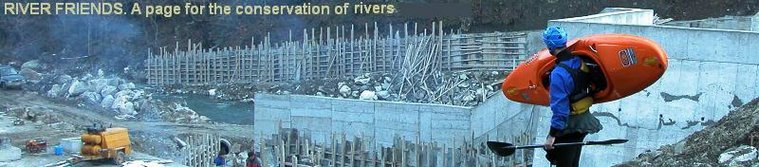
Working Hard to Safeguard Paddling Assets for All Canadians

All about Whitewater

All about Whitewater
A Blog about River Preservation and the need to protect our free flowing whitewater resources

Friday, March 16, 2007

Today's Rivers, Tomorrows Nightmare


Stay tuned for my draft paper: Les Amis Experience with the Laniel Dam Refurbishment Project - putting teething into CEAA screening assessments.

River Modification Policy


Whitewater Ontario
Policy Manual

Item:

Conversion of whitewater paddling potential to hydro power supply

Date: 2007 03 12

Organizations Affected:
Ontario Power Authority Supply Planners, IPSPsubmissions@powerauthority.on.ca.

Approved by Whitewater Ontario Executive: Not yet approved
Review Dates:

Preamble

Whitewater Ontario, a not-for-profit organization under the umbrella
of Canoe Ontario serves as the voice of paddlers' interests to government and business. We are the designated provincial whitewater sport paddling organization and owner/operator of the Minden Wild Water Preserve in Minden. We have a membership of around 500 active members, 6 active clubs, and 25 corporate members across the province.

We believe that the best development is one which takes into consideration the multiple values of a resource. Whitewater Ontario is very interested in all aspects of river development which may impinge upon the traditional rights of whitewater recreational and commercial paddlers.

Our organization wants to increase access to whitewater resources and work cooperatively to develop whitewater recreation opportunities in Ontario and Canada.

Navigability

Rivers must be regarded as public navigable rivers in law when they are navigable in fact. And they are navigable in fact when they are used, or are susceptible of being used, in their ordinary condition, as highways for commerce, over which trade and travel are or may be conducted in the customary modes of trade and travel on water - this definition has been expanded to include recreational whitewater paddling use.

1. A river is regarded as a “public navigable river” if it is susceptible of being used in its ordinary condition as a highway for commerce over which trade and travel are or may be conducted in the customary modes of travel and trade on water.
2. A river that is navigable in fact is navigable in law.
3. The test of navigability, as applied to “navigable waters,” is the capability of being used for useful purposes of navigation, of trade and travel in the usual & ordinary modes, and not the extent and manner of such use.

The beds of rivers flowing through public lands are usually owned by either the federal or provincial government. These rivers are open for public use, and subject only to regulation by the agency managing the adjacent lands.

Legal cases have established the fundamental understanding that the management of public natural resources must avoid substantial impairment of natural resources, the appearance of discrimination between competing uses, and implementation of discriminating fees.

Furthermore, despite the recent advertising and promotional campaigns by Ontario Power Generation Corp, (OPG) There is no evidence that recreational canoe and kayak access downstream of dams poses a security risk and further, in the case of Les Amis de la Riviere Kipawa vrs. the attorney General there is no evidence that navigating the sluice of a properly designed water control sluiceway is dangerous.

Whitewater enthusiasts are often stereotyped as mindless thrill-seekers with a death wish. The reality is quite different. Paddlers represent a true cross-section of our society and include many highly educated professionals. They know the limits of their skills, and by choosing what rapids they run, they control the intensity of their experience. It is a life-long sport that nurtures a love for wild places and an appetite for low-impact, human powered travel. Extreme paddlers are especially calculating when exposing themselves to danger. Today 28% of all Canadians currently participate in – or intend to participate in – this type of activity.

Whitewater paddlers, like other risk sport enthusiasts, approach their activity with a focus and intensity not often found in traditional outdoor recreation. They’re aware of the dangers and take concrete steps to avoid them. They purchase highly specialized equipment and work hard to develop the skills they need. They condition themselves mentally and physically and learn first aid and rescue skills before setting out. They have a strong sense of personal responsibility and a full understanding of the consequences of their actions. Drug and alcohol abuse is quite rare. Because of their expertise and involvement the actual risks they face are not much more than those encountered by inexperienced people in traditional outdoor recreation slightly fewer deaths than rock climbing and slightly more deaths than recreational swimming.

Natural Rivers

Whitewater Ontario opposes modifications to natural, free-flowing rivers, to rivers that have been designated as wild or scenic, and to rivers which have been named by managing agencies as eligible or suitable for such designation.

Case by Case Decisions
Whitewater Ontario views proposals for river modification with caution, recognizing that changes, once made, may be difficult or impossible to unmake and in many cases may create new and often more dangerous conditions. Whitewater Ontario may oppose, not oppose, or endorse proposed modifications to rivers depending upon the specific needs, impacts and details associated with this action. Whitewater Ontario may assist with planning or funding of river modifications if it endorses those modifications.

Authority
Guided by this River Modification Policy, Whitewater Ontario will either support or not support proposed river modifications. Before choosing to endorse a river modification, the President will consult with the appropriate Committees and seek ratification by the Executive of Whitewater Ontario.

No Harm Policy
Whitewater Ontario will oppose proposals for river modifications unless it has reason to believe that the proposed modification will not adversely impact the enjoyment of rivers by other recreational groups and will not have a significantly adverse effect on the riverine ecosystem.

Categories of Modifications
Whitewater Ontario considers modifications to rivers associated with recreational paddling to be for one of three purposes: for enhancing safety, improving navigability, or enhancing recreational opportunities.

Enhancing Safety
Modifications for the purpose of enhancing safety include changes that remove or reduce objective dangers, such as demonstrated entrapment hazards. A decision by Whitewater Ontario in favor of safety modifications is more likely if

(a) the modification does not change the physical or visual characteristics of a rapid,
(b) the river receives a high level of use, and
(c) the hazard in question has been demonstrated to cause drownings or near drownings.

Improving Navigability
Whitewater Ontario opposes river modifications for the purpose of improving navigability including changes to rapids that make passage of boats easier or that reduce the difficulty rating of rapids.

The organization recognizes that portaging is usually an option for avoidance of specific obstacles and that advances in technique, skill, and equipment have historically made impossible rapids possible and difficult rapids routine.

Presently, unrunnable or difficult rapids are tomorrow’s first descents or play spots.
It is Whitewater Ontario's position that there is a firm distinction to be made between improvements for the purpose of improving navigability and those made for reduction of objective hazards.

For this reason, a proposed modification to remove a subjective hazard (such as a wave that routinely flips rafts) or to reduce the overall difficulty of a rapid is considered by Whitewater Ontario as a modification for the purpose of improving navigability rather than safety.

Enhancing Recreational Opportunities
Modifications for the purpose of enhancing recreational opportunities range from moving a few rocks to enhance a play hole to the construction of a completely artificial whitewater race course. A decision by Whitewater Ontario on proposed recreational enhancements hinges on the degree of previous modification of the river, the degree of terrestrial development along a river, impact of the proposal on the riverine and riparian ecosystems, and impact on enjoyment or future enjoyment by other recreational users. For example, Whitewater Ontario would oppose modifications for recreational enhancement of a pristine, wilderness river, but might choose to endorse the construction of a play hole in a highly modified, urban river.

Artificial Structures Obstructing Navigability
Whitewater Ontario opposes construction of structures or artificial placement of natural and synthetic materials which may interfere with navigation. These structures include but are not limited to dams, weirs, bridges, fences, and fish habitat structures.

At existing low head dams, Whitewater Ontario advocates dam removal or modification for safe passage. In cases where modifications are not possible, Whitewater Ontario advocates availability of portage routes.


Stakeholder Involvement and Agency Approval

Whitewater Ontario will not endorse river modifications on whitewater rivers which do not seek public input and comment. Public comment must include Whitewater Ontario, local whitewater clubs, and other local regional and national river recreation and conservation organizations. Whitewater Ontario will also not endorse any river modification proposal that has not obtained the necessary managing agency permission prior to construction.

In general, Whitewater Ontario opposes river modifications made without consultation with a broad spectrum of user groups or made without agency authorization and which have not made signficant and best efforts to mitigate environmental effects on whitewater navigation.


Whitewater Ontario would like to be directly notified, via email dispatches, of pending river development projects that may impinge upon traditional whitewater paddling activities including bridges, or dams, which may curtail traditional navigation as described under the Navigable Waters Protection Act and any shore side development which may curtail traditional access and portage rights.



The New Whitewater Ontario, actively pursuing issues for the good of Ontario paddlers:

Letter to MNR:

Robert Taylor
Director of the Lands & Waters Branch
Ontario Ministry of Natural Resources
P.O. Box 7000
300 Water Street
Peterborough, Ontario
K9J 8M5


I understand the Ministry of Natural Resources has a Renewable Energy
Program in place to facilitate, among other things, the development of small hydro-power projects in Ontario.

Whitewater Ontario is a not-for-profit organizaton under the umbrella of Canoe Ontario. Whitewater Ontario is here to serve as the voice of paddlers interests to government and business. We want to increase access to whitewater resources and work cooperatively to develop whitewater recreation opportunities in Ontario and Canada. We are the designated provincial whitewater sport paddling organization and owner/operator of the Minden Wildwater Preserve in Minden. We have a membership of around 500 active members, 6 active clubs, and 25 corporate members across the province.

Whitewater Ontario is very interested in all aspects of river development which may impinge upon the traditional rights of whitewater recreational and commercial paddlers. We wish to establish a dialogue with key Ministry (MNR) Contacts and take steps to ensure that Whitewater Ontario and/or its affiliates will be considered as potential intervenors, committee members and stakeholders of record for the development of new water management
plans in the province.

As an organization, we are responsible for acting in and speaking for the interests of our members - the paddling community.

As whitewater paddlers, our interests often overlap with the interests of hydro-power development. But we understand that is the reality of resource use today, and that the best development is a development that takes into consideration all of the values of a resource.

We are dismayed by case on a Quebec river that is currently being argued in federal court, where a dam owner completely ignored the navigation rights of paddlers in contravention of the Navigable Waters Protection Act.

We believe that the courts are not the place to resolve issues of
conflicting resource use. We believe we can help the province and
hydro-developers work through navigation rights issues on rivers in a
collaborative way.

Whitewater Ontario would like to be directly notified, via email
dispatches, of pending river development projects that may impinge upon traditional whitewater paddling activities including bridges, or dams, which may curtail traditional navigation as described under the Navigable Waters Protection Act and any shoreside development which may curtail traditional access and portage rights.

To this end, please record Whitewater Ontario as a stakeholder of record on all new site applications. We believe the number of new site projects that paddlers will have concerns about will be small. In those situations, we will be able to provide assistance in the public consultation, environmental assessment and impact assessment phases.

Your assistance would be appreciated in achieving these objectives.

Yours truly,


Peter Karwacki

cc to the Minister of Natural Resources the Honorable David Ramsey

Early Days: Paddling Clubs may help save our rivers


**********Have a Nice Day**********

Tabaret Rears its Ugly Head

The transfer of the Dam to Quebec for the purposes of Tabaret was already mentioned in the Kipawa Dam Operating Manual. The environmental assessment of the dam refurbishment did not even address this point.

Further, the dam is now being transferred in a renovated state: basically a cash transfer from the Taxpayers of CANADA to the province of Quebec.

This happens no where else that I know of.


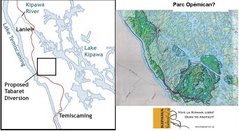
The refurbished dam creates a more perfect diversion for the Tabaret Project. Note the Opemican Park NOTCH elsewhere on this site.

Once the tap is turned of that's it for the Kipawa, once mighty it becomes a dried out gulch.


For details read below:


No: T-452-06
COUR FÉDÉRALE
ENTRE:

LES AMIS DE LA RIVIÈRE KIPAWA,
incorporated as 1162209036 QUEBEC INC.
Plaintiff
and

THE ATTORNEY GENERAL OF CANADA and THE MINISTER OF PUBLIC WORKS AND GOVERNMENT SERVICES CANADA, THE MINISTER OF FISHERIES AND OCEANS, THE MINISTER OF TRANSPORT, and
DAVID S. LAFLAMME CONSTRUCTION INC.
Defendant


Synopsis

This case involves a federal court application by Les Amis de la Rivière Kipawa for judicial review of a decision by Transport Canada and PWGSC to eliminate historic navigation rights on the Kipawa River at the location of the Laniel flood control dam in Laniel Quebec.


Note to long afterwards we see this:

Minister Fortier Confirms the Intention of the Government of Canada to Transfer Three Dams to the Government of Quebec


CCNMatthews; 8/24/2006


The Honourable Michael M Fortier, Minister of Public Works and Government Services, today announced the decision of the Government of Canada to transfer the management of three dams, located in the Temiscamingue region, to the Government of Quebec. Negotiations between the Government of Canada and the Government of Quebec are expected to be finalized by the end of 2006.

"This transfer will allow the Government of Quebec to obtain an asset well-suited to its mandate to manage its own energy and natural resources, while allowing the federal government to focus on our federal priorities," said Minister Fortier, adding, "this is a concrete demonstration of the vision of federalism of the new Government of Canada".

The transfer of these dams is consistent with federal government policy to divest of assets that are not supportive of federal programs. Once the transfer takes place, the province will assume full responsibility for the operation, maintenance and improvements of the three dams.

The transfer of the Kipawa and Des Quinze Dams, along with the agreement to transfer Laniel, may take place in 2007. The Government has agreed to delay the actual transfer of the Laniel Dam to take place only when its reconstruction has been completed. The contract was awarded in November 2005 and the work is underway.

The transfer will include the reconstruction of the Laniel Dam, and a financial compensation from the Government of Canada. This compensation will represent the actual value of the capital costs to repair and operate the dams for a period of 20 years, which will allow the Government of Quebec to continue to operate, maintain and upgrade the three dams.

The three dams were all constructed by the Government of Canada between 1912 and 1914 to control water levels on the Ottawa River.

Ce texte est egalement disponible en francais.

BACKGROUNDER

TRANSFER OF THE LANIEL, KIPAWA AND DES QUINZE DAMS TO THE GOVERNMENT OF QUEBEC

The Government of Canada has confirmed the intention to transfer three dams in Temiscamingue to the Government of Quebec. The transfers of the Kipawa and Des Quinze dams will take place in early 2007, after the Government of Quebec has concluded its approval process. This transfer will include a financial compensation from the Government of Canada to allow the Government of Quebec to continue maintenance and upgrades of the dams. The federal government will complete a reconstruction project at Laniel Dam, currently underway, before the transfer of this dam takes place.

The federal government built the three dams in the early part of the twentieth century, to control the water level of the Ottawa River. They are all landmarks in their local communities and have benefited the local community and attracted tourists.

The Laniel Dam is located across the Kipawa River at the outlet of Kipawa Lake, in the town of Laniel, Quebec. It is a concrete gravity dam with two gates, approximately 31 metres in length. This dam was constructed between 1910 and 1912. Major repairs were undertaken on the deck, piers and abutments in 1988, 1993 and 1996. A contract was announced in November 2005 to rebuild the dam, for health and safety reasons. The contract was awarded to David S. Laflamme Construction Inc., and the work will likely be completed in 2008. The federal Government has agreed to ensure that this work is completed before the dam is transferred to the Government of Quebec.

The Kipawa Dam is across Gordon Creek at the outlet of Kipawa Lake in the town of Kipawa, Quebec. It is a concrete gravity dam with bottom gates and is about 10 meters long. This dam was built between 1910 and 1912. The roadway deck was rebuilt in 1993 and 1994. It has been regularly inspected, maintained and is in good condition.

The Des Quinze Dam is across the Ottawa River at the outlet of Quinze Lake, in the village of Angliers, Quebec. It is a concrete gravity dam complete with 19 gates measuring approximately 143 metres long. There is also a long dike on the north-west side and a secondary dike to the east. This dam was constructed between 1911 and 1914. It was later reconstructed in 1939 and 1940, just downstream of the old dam. The roadway deck was widened in 1990 and part of the operating deck was rebuilt. The remaining part of the operating deck was rebuilt in 1996 and 1997, leaving it in good condition.

All of these transfers will provide the Province a valuable natural resource that will benefit the people of Quebec.

SOURCE: Public Works and Government Services Canada


Office of Minister Fortier
Jean-Luc Benoit
Director of Communications
(819) 997-5421
Public Works and Government Services Canada
Media Relations
(819) 956-2315


**********Have a Nice Day**********

How to ruin a World Class Paddling Resource


Canadian Rivers

Canadian Rivers
I speak for river users too!

The Queen is not amused!

The Queen is not amused!
http://www.ispeakforcanadianrivers.ca/

The Damned Dam - 2005 -

The Damned Dam - 2005 -
22nd Annual Kipaw Rally has modest turnout. - 23rd does better

The Ashlu river: it could happen to you

The Ashlu river: it could happen to you

Whitewater Ontario

Whitewater Ontario
Working Hard to Protect Canada's Paddling Resources

Whitewater Ontario - Mission Statement

It is Whitewater Ontario’s mission to support the whitewater paddling community through the promotion, development and growth of the sport in its various disciplines. We accomplish this through the development of events, resources, clubs, and programs for personal and athletic development, regardless of skill level or focus, to ensure a high standard of safety and competency; We advocate safe and environmentally responsible access and use of Ontario’s rivers. Whitewater Ontario is the sport governing body in the province, and represents provincial interests within the national body Whitewater Canada and the Canadian Canoe Association http://www.whitewaterontario.ca/page/mission.asp

Kipawa, Tabaret, and Opemican

Kipawa, Tabaret, and Opemican
If Hydro Quebec is not actively pursuing Tabaret what is that bite out of Opemican for?

Kipawa Dam: After

Kipawa Dam: After
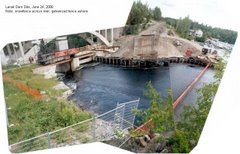
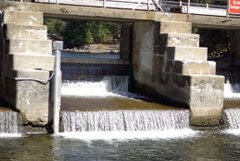
Laniel Dam at 2006 Rally

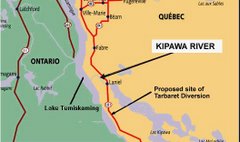
Where is the Kipawa

Where is the Kipawa
Kipawa flows into lake Temiskamingue, running from Kipawa Lake, under hwy 101 in Quebec

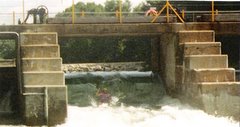
Kipawa Dam

Kipawa Dam
laniel dam at 2004 River Rally

Tabaret is a Bad Idea

About the Kipawa


The best thing paddlers can do to help the cause of the Kipawa:

1. attend the rally and bring others including non paddlers to attend and buy beer and have fun

2. write your MP /MNA and raise the issue and post your objections -1 letter = 200 who didn't write

3. Write Thierry Vandal the CEO of Hydro Quebec strongly opposing the 132 MW standard decrying the use of "diversion" as the most environmentally inappropriate method of power production

4. Write Jean Charest, Premier of Quebec protesting that either the algonquin or the tabaret project will eliminate all other values on the Kipawa River by turning it into a dry gulch.

5. See if you can get other allied groups interested by showing your own interest, ie the Sierra Defense Fund, Earthwild, MEC, and so on.

6. Demand further consultation

7. Currently we are at the point where we need to sway public opinion and raise awareness.

However, if all else fails, don't get mad, simply disrupt, foment, and protest . The Monkey Wrench Gang.

Have you read Edward Abbey?

Important Addresses
CEO,Hydro Québec, 75 boul René Levesque, Montreal, P.Q., H2Z 1A4Caille.andre@hydro.qc.ca


Tabaret is a Bad Idea (Part Two)

Les Amis de la Riviere Kipawa is poised to use an application to the Federal Court to issue a Writ of Mandamus to ensure the Minster does what he is supposed to do, protect the public's right to navigate the water control structure at Laniel, Quebec using the Navigable Waters Protection Act. (see http://www.kipawariver.ca/)

In the now gutted Navigable Waters Protection Act lay the means by which the Minister of Transport could keep the public right of passage down our great Canadian Heritage, our rivers and streams which are threatened especially by resource corporations and power brokers such as Hydro Quebec.

These powerful entities continue to petition that 'this' river or 'that' stream is not navigable and therefore not protectable.
I don't say that dams and bridges should not be built, only that if they are, historical navigation rights should be considered and preserved by making reasonable accommodations for recreational boaters.

It is the Minister of Transport, in exercising the right to allow or disallow work on or over a navigable waterway is what keeps boats and recreational boaters plying our waterways.

To many recent cases launched in the Federal Court concerning the Navigable Waters Protection Act, most recently the case of the Humber Environment Group of Cornerbrook Newfoundland versus the Cornerbrook Pulp and Paper Company indicates that the important oversight is not being faithfully performed. Have we really come to the point now where we must say "such and such a stream is one foot deep, possessing so many cubic feet per second flow and so on?" The answer to this is... YES!

The honourable Mr. Justice John A. O'Keefe, ruled that it had not been shown that the river was navigable. How convenient was that to the Minister? But either the Minister of Transport acts to protect our rivers and streams as a public right or he does not and that means rivers and streams currently enjoyed by kayakers and canoists.

Enough of the cheating, and double-talk. Canadians! our rivers and streams are our own, lets urge the Minister of Transport and the our government to protect them.

Peter Karwacki

Tabaret is a Bad Idea (Part Three)

10 Reasons WhyTabaret is a Bad Idea1) Tabaret is too big. The station is designed to useevery drop of water available in the Kipawawatershed, but will run at only 44 percent capacity.We believe the Tabaret station is designed to usewater diverted from the Dumoine River into theKipawa watershed in the future. 2) The Tabaret project will eliminate the aquaticecosystem of the Kipawa River.The Tabaret project plan involves the diversion of a16-km section of the Kipawa River from its naturalstreambed into a new man-made outflow from LakeKipawa. 3) Tabaret will leave a large industrial footprint on thelandscape that will impact existing tourismoperations and eliminate future tourism potential. 4) The Tabaret project is an aggressive single-purposedevelopment, designed to maximize powergeneration at the expense of all other uses. 5) River-diversion, such as the Tabaret project, takinglarge amounts of water out of a river’s naturalstreambed and moving it to another place, is verydestructive to the natural environment. 6) The Kipawa River has been designated a protectedgreenspace in the region with severe limitations ondevelopment. This designation recognizes theecological, historical and natural heritage value ofthe river and the importance of protecting it.Tabaret will eliminate that value. 7) If necessary, there are other, smarter and morereasonable options for producing hydro power onthe Kipawa watershed. It is possible to build a lowimpactgenerating station on the Kipawa river, andmanage it as a “run-of-the-river” station, makinguse of natural flows while maintaining other values,with minimal impact on the environment. 8) The Kipawa watershed is a rich natural resource forthe Temiscaming Region, resonably close to largeurban areas, with huge untapped potential fortourism and recreation development in the future.Tabaret will severely reduce this potential. 9) Tabaret provides zero long-term economic benefitfor the region through employment. The plan is forthe station to be completely automated andremotely operated. 10) The Kipawa River is 12,000 years old. The riverwas here thousands of years before any peoplecame to the region. The Tabaret project will change all that.

Problems on a local River?

  • There is more to do as well but you have to do your research and above all, don't give up.
  • IN the meantime prepared a document itemizing the history of navigation of this spot and its recreational value. Use the Kipawa river history of navigation as a guide: see www.kipawariver.ca
  • Under the Ministry of Environment guidelines you have a set period of time to petition the change under the environmental bill of rights, you may have limited time to take this action. But it involves going to court for a judicial review of the decision.
  • 4. contact the ministry of natural resources officials and do the same thing.
  • 3. contact the ministry of the environment and determine if they approved the project
  • 2. determine if the dam was a legal dam, approved under the navigable waters protection act.
  • 1. research the decision and timing of it to determine if an environmental assessment was done.

Minden Ontario

Minden Ontario
Gull River Water control at Horseshoe lake

A History of Navigation on the Kipawa River

Prior to the environmental assessment there was no signage at the Laniel Dam

T-Shirts Area: These are available now!

T-Shirts Area: These are available now!
Send $25 and a stamped self addressed envelop for the Tshirt, and for the bumper sticker, a stamped and self addressed envelope with $5.00 for the bumper sticker to Les Amis de la rivière Kipawa, 80 Ontario St., Ottawa, Ontario, K1K 1K9 or click the link To purchase a Les Amis "T" contact Doug with the following information: Number of shirts:Sizes: Ship to Address: Method of Payment: cash, cheque and paypal, Shipto address:

Bumper Stickers Now Available

Bumper Stickers Now Available
Get your bumper sticker and show your support for the Kipawa Legal Fund ! - send $5.00 in a Stamped, self addressed envelope to: Peter Karwacki Box 39111, Ottawa, Ontario, Canada, K1H 7X0