Working Hard to Safeguard Paddling Assets for All Canadians

All about Whitewater

All about Whitewater
A Blog about River Preservation and the need to protect our free flowing whitewater resources

Thursday, August 21, 2008

A question to politicians regarding proposed changes to the NWPA


A question for Stephane Dion,the Liberal Party and any other political wannabees

Answers will be posted on the "I Speak for Canadian Rivers Site" www.canadianrivers.com and forwarded to the more than 100 various outdoor user groups now aware of this and making statements on their web sites.

...My question deals with the proposed changes to the Navigable Waters Protection Act.

The majority of modern Canadians are completely unaware of the great gifts that this piece of legislation has given us. This legislation is almost as old as the country and was put in place with great foresight by the early Canadian governments, a country which was built on the ability of an open canoe to navigate the vast water resources that we so sadly continue to exploit.

This act, enshrined in law, drafted to give all Canadians access to that resource and to protect that water for future generations the ability to canoe, kayak, power boat, to fish and to hunt, much the same as Canadians 100 years ago, except instead of doing it to survive we do it for recreation.

In the recent past Canadians have learned to use the act for protection of their water ways because the act required that "works" be advertised, giving a chance for concerned citizens to voice their concerns over proposed works. If Canadians even 40 years ago showed the same concern for their environment we would not be using huge amounts of tax dollars to rehabilitate the many cement ditches and destroyed urban watersheds.

At the 11th hour, various out door groups became aware of the proposed changes to the act by the TRAN committee, Chaired by Conservative member of Parliament Merv Tweed of the riding Brandon-Souris and what we found very unsettling was the fact that the stakeholders that were made aware of these meetings were very one-sided (no outdoor user groups were properly invited or made aware of the hearings).

As a Canadian in what is supposed to be a democratic country I found this treatment and their responses towards the outdoor user groups completely unacceptable and frightening.

We can understand the need for changes,
We can also understand the need for a fast track mechanism to build infrastructure projects.

But we also understand that these works need to be done in an environmentally way as to safeguard the health of the watersheds.
There should be approved construction/water treatment processes that evolve with technological advancements.
We also believe that the Canadian public should not have to subsidize industry so that they may profit. A case in point is the 16 lakes/watersheds that have been requested to be made into tailing ponds.
These are just more “Sydney tar ponds” disasters in the making, If the costs of protecting the environment makes the business of mineral or resource extraction unprofitable then the taxpayer shouldn’t make up the difference.

How can we protect/preserve National Parks such as Nahanni, let alone the few areas of old growth forests and urban water sheds that are left with the “Gutting” of our environmental laws that has taken place over the last couple of years?
There is definitely a pattern here where industries cry poor and can not create employment or compete with other international companies, they then lobby, change the laws so that their profit margins increase, and then leave environmental disaster areas, and then claim they do not need to pay for the clean up because it was done under existing laws.

The proposed changes to the Navigable water act are a perfect example of this, and by also denying/removing our heritage rights to access these areas, alarm bells can not be sounded to the desecration of these water sheds.

What is your position on the changes to the Navigable waters Protection Act?
Are you going to ensure that the present right to navigate “small waters” be enshrined in new legislation?
Are you going to restore the right of Canadians to be properly notified and be involved in shaping Canada’s future in this and other committee hearings?


Jeff McColl

Thursday, August 14, 2008

RCEN writes a nice letter to Lawrence Canon Minister of Transport - Les Amis Signs

July 28, 2008
The Honourable Lawrence Cannon
Minister of Transport, Infrastructure and Communities
Tower C - 330 Sparks St.
Ottawa, Ontario, Canada
K1A 0N5
Re. : Environmental Non-Government Organization (ENGO) response to proposed changes to the federal Navigable Waters Protection Act
Honourable Minister:
As member organizations and supporters of the National Water, Fisheries and Oceans Caucus (“Water Caucus”) of the Canadian Environmental Network, we are writing to you regarding our concerns on the proposed changes to Canada’s Navigable Waters Protection Act by the Standing Committee on Transport, Infrastructure and Communities.
The Canadian Environmental Network is a network of environmental non-government organizations (ENGOs) across Canada which coordinates the work of national caucuses made up of participants drawn from its affiliated member groups. The scope of the Water Caucus includes issues related to water quality and quantity, oceans and fisheries, with the main objectives of sharing information, developing joint strategies, helping each other, and providing advice to the government.
The undersigned members of the Water Caucus believe that the Standing Committee did not provide adequate consultation on the proposed amendments to the NWPA, given that organizations invited to provide submissions did not include paddling organizations – commercial or recreational. The proposed changes to the NWPA could have a profound effect on the activities of paddling organizations on Canadian waterways.
Further, we were disappointed to see that the recommendations of the few organizations that did make submissions were largely ignored. Lake Ontario Waterkeeper, for example, suggested in their submission of May 12, 2008 that three of the proposed amendments could impede free passage and have serious impacts on the protection of navigable waterways in Canada. The specific amendments of concern include changing the definition of “navigable waters” and “work,” as well as deleting the four “named” works from the Act. Lake Ontario Waterkeeper believes that these changes should not be put forward without further consultation and study. However, in their June 12, 2008 news release, the Standing Committee recommended that the government go ahead with all of the amendments to the NWPA that they believe “could be resolved quickly,” including the amendments Waterkeeper advised against pursuing.
While the Standing Committee’s news release does indicate further consultations will be made on this piece of legislation, we have reason to be concerned that future consultations and follow-up will be inadequate, given the actions of the Standing Committee to date, as outlined in this letter.
On behalf of the Canadian Environmental Network’s Water Caucus, we respectfully request a meeting with Transport Canada in order to address our concerns with public consultation regarding amendments to the NWPA.
Sincerely,
Alberta Wilderness Association, AB
Canadian EarthCare Society, BC
Concerned Citizens for a Safe and Healthy Environment, SK
Conservation Council of New Brunswick
Coureurs de Bois Club Ottawa, ON
David Suzuki Foundation
Dog Lake Association, ON
Federation of Alberta Naturalists, AB
Friends of Lily Lake, NB
Friends of the Oldman River, AB
Georgia Strait Alliance, BC
Grand Riverkeeper Labrador, Inc, Nf/Ld
Great Lakes United, ON
Lake Ontario Waterkeeper, ON
Les Amis de la Riviere Kipawa, ON
Les Intendants du Madawaska, NB
The Onoway River Valley Conservation Association, AB
Petitcodiac Riverkeeper, NB
Safe Drinking Water Foundation, AB Chapter
Shearwater Marine Services, SK
Sierra Club Canada
Soil and Water Conservation Society, BC Chapter
South Peace Environment Association, AB
Whitewater Ontario, ON
Yukon Canoe and Kayak Club, YK

cc. The Honourable John Baird, Minister of the Environment
House of Commons Standing Committee on Transport, Infrastructure and Communities
David Osbaldeston, Manager, Navigable Waters Protection Program
Krystyn Tully, Vice-President, Lake Ontario Waterkeeper

Monday, June 30, 2008

How will the proposed changes to the navigable waters protection act affect you and your organization?


In January of this year, Lawrence Cannon, the federal Minister of Transport asked the Standing Committee for Transport, Infrastructure and Communities (TRAN) to begin hearings on proposed changes to the Navigable Waters Protection Act (NWPA).
Pursuant to its mandate under Standing Order 108(2), the Committee has studied the proposed amendments and has published his report named "CONSIDERATION OF PROPOSED AMENDMENTS TO THE NAVIGABLE WATERS PROTECTION ACT" on June 12th, 2008.
http://cmte.parl.gc.ca/cmte/CommitteePublication.aspx?COM=13202&SourceId=243590
Hereafter you will find excerpts of this report and related excerpts of the hearings.

A. Definition of Navigable Waters
The government amend the definition of navigable waters to exclude minor waters and that the new definition should clearly state what constitutes a “navigable water.”

Mr. David Osbaldeston (Manager, Navigable Waters Protection Program, Department of Transport) (12/02/2008-1205):
http://cmte.parl.gc.ca/Content/HOC/committee/392/tran/evidence/ev3274882/tranev13-e.htm#T1205
"Right now, in accordance with what the courts have determined, if you can float a canoe or a kayak, regardless of how long or how far, it's navigable."

Mr. Don Johnson (President, Alberta Association of Municipal Districts and Counties, Federation of Canadian Municipalities) (29/04/2008-1120) :
http://cmte.parl.gc.ca/Content/HOC/committee/392/tran/evidence/ev3453770/tranev23-e.htm#T1120
"For further clarity, a navigable water:

(a) must be, for at least three consecutive months of the year, capable of supporting typical transportation, commercial, or recreational type floating vessels that draw a draft of at least one metre;

(b) must be at least two kilometres in length and contain no fixed and permanent restrictions for floating vessels referred to earlier...;

(c) may be a man-made or naturally occurring water body...

In addition, a water body meeting all these criteria may be nominated for designation as a navigable water by one level of government only, either municipal, provincial, or federal."

Question 1:
If navigation is denied on bodies of water that don't comply to Mr. Don Johnson's proposed criterions, do you think this denial would have an impact on your or on your organization activities ?

B. Definition of Work
The government amend the definition of “work” under the NWPA to exclude “minor works.”

Mr. Brian Masse (Windsor West, NDP) (28/02/2008-1205):
http://cmte.parl.gc.ca/Content/HOC/committee/392/tran/evidence/ev3312419/tranev14-e.htm#T1205
"I looked at the minor works, and you had dredging, submarine cables, docks, pipeline crossings. "

TC: http://www.tac-atc.ca/private/environment/pdf/att3-0406.pdf
"List of minor works:
dredging, submarine cables, docks, pipeline crossings, riprap, intakes, winter crossings. "

Question 2:
Do you think dredging, submarine cables, docks, pipeline crossings, riprap, intakes, winter crossings don't have a meaningfull impact on navigation ?

C. Remove Reference to Four “Named” Works
The government consider deleting specific reference to each of the four “named“ works under Section 5(2) of the Navigable Waters Protection Act without compromising the review of works which impede or obstruct navigation.

Ms. Shirley Anne Scharf (Director General, Issues Management Directorate, Program Operations Branch, Infrastructure Canada) (11/03/2008-1115):
http://cmte.parl.gc.ca/Content/HOC/committee/392/tran/evidence/ev3350146/tranev16-e.htm#T1115
"In addition, the proposal to remove the named works from the NWPA would also allow for quicker approval of those named works that are not a significant interference to navigation, such as small bridges, causeways, and micro-hydroelectric projects. "

Mr. Marc Grégoire (Assistant Deputy Minister, Safety and Security, Department of Transport) (28/02/2008-1140):
http://cmte.parl.gc.ca/Content/HOC/committee/392/tran/evidence/ev3312419/tranev14-e.htm#T1140
"Subsection 5(2) of the act contains four named works. They are “bridge, boom, dam...[and] causeway”. These four works were originally named, back in 1882, specifically in the act, as they completely blocked the waterway and thus were traditionally considered significant interferences to navigation. Today in 2008, this is not true any more."

Question 3:
Do you aggree with Mr.Gregoire on the fact the navigation has evolve in a way that it can no more be impeded or obstructed by bridges, booms, dams and causeways ?

D. Inter-Departmental Assessment “Triggers”
The government, in amending the NWPA, ensure that the “trigger” mechanisms contained in other pieces of relevant legislation for environmental assessments and fisheries habitat assessments are not done away with or impeded.

Mr. John Smith (Director, Legislative and Regulatory Affairs, Policy Development, Canadian Environmental Assessment Agency) (11/03/2008-1120):
http://cmte.parl.gc.ca/Content/HOC/committee/392/tran/evidence/ev3350146/tranev16-e.htm#T1120
"In factoring environmental considerations into the planning and decision-making process at an early stage, EA is an important tool for promoting sustainable development...

The proposed changes to the NWPA would mean that minor works and projects in minor waters would not require NWPA approval; consequently, they would not trigger an environmental assessment."

Mr. David Osbaldeston (Manager, Navigable Waters Protection Program, Department of Transport) (12/02/2008-1255)
http://cmte.parl.gc.ca/Content/HOC/committee/392/tran/evidence/ev3274882/tranev13-e.htm#T1255
"Suppose MacMillan Bloedel wants to go into a piece of New Brunswick...
In the past they used to come in and say they were going to clear-cut up here, and were there any navigational concerns?...
We'd take a quick look at it and we'd say no--just go. They'd go in and they'd do their thing with their temporary bridges....
Then came the introduction of ISO standards...
All of a sudden we start having these guys show up with 3,000 applications in hand, saying now they need us to produce 3,000 pieces of paper for them on waterways that for the most part would be covered under these minor waterways that nobody's ever going to put a canoe or a kayak on...
In a changed act, one way would be that if you had 3,000 bridges that really mattered, all on a similar type of waterway on a given project, you could come to us and maybe we'd review it and issue you one document for the 3,000 bridges"

Question 4:
Knowing that selective cuts allow to reach a productivity which is 3 times higher than clear cuts, do you think that the proposed changes would transform the NWPA in a important tool for promoting sustainable development ?

Mr. David Osbaldeston (Manager, Navigable Waters Protection Program, Department of Transport) (28/02/2008-1215):
http://cmte.parl.gc.ca/Content/HOC/committee/392/tran/evidence/ev3312419/tranev14-e.htm#T1215
"As you can see, there's very little we deny or refuse. I think that's the main thing: if somebody has a need to put something in the water, over the water, under the water, or through the water, and has a valid need to do it, we'll try our utmost to get it done in a safe manner."

Question 5:
Do you think this is the best way to protect your navigation rights ?

Ms. Shirley Anne Scharf (Director General, Issues Management Directorate, Program Operations Branch, Infrastructure Canada) (03/06/2008-1115):
http://cmte.parl.gc.ca/Content/HOC/committee/392/tran/evidence/ev3543792/tranev30-e.htm#T1115
"Certainly I understand the concerns of the waterkeepers and their concerns about the environment. So we appreciate that fact. And we have not been engaged in consultations with them....
1220
With respect to your question about canoeists and whitewater enthusiasts, because Transport Canada was administering the act, they have led any consultations that have occurred."

Question 6:
Was your organization consulted on the proposed changes of the NWPA ?

Question 7:
Was your organization informed of the hearings on the proposed changes of the NWPA ?

Mr. Marc Grégoire (Assistant Deputy Minister, Safety and Security, Department of Transport) (12/02/2008-1120):
http://cmte.parl.gc.ca/Content/HOC/committee/392/tran/evidence/ev3274882/tranev13-e.htm#T1120
"This committee is the ideal forum in which to seek the viewpoints of stakeholders who have a vested interest in a new Navigation Protection Act. The committee would provide Transport Canada with an unbiased consideration of the issues and could look at solutions from a fresh perspective. This would be vitally important to the initiative's outcome...
The Navigation Protection Act impacts a wide range of Canadians and areas."

Question 8:
Based on the List of Witnesses (Appendix A) and List of briefs (Appendix B) of the report, do you think the committee could address all the interests of Canadians about the NWPA ?

http://cmte.parl.gc.ca/cmte/CommitteePublication.aspx?COM=13202&SourceId=243590
Appendix A
List of Witnesses

Department of Transport
Marc Grégoire, Assistant Deputy Minister, — Safety and Security
David Osbaldeston, Manager, — Navigable Waters Protection Program
William J. Nash, Director General, — Marine Safety

Canadian Environmental Assessment Agency
Steve Burgess, Acting Vice-President, — Program Delivery Sector
John Smith, Director, — Legislative Regulatory Affairs, Policy Development
Yves Leboeuf, Vice-President, — Policy Development

Department of Fisheries and Oceans
Gilles Belzile, Director General, — Legislative and Intergovernmental Affairs, Policy Sector
Ginny Flood, National Director, — Environmental Assessments and Major Projects, Oceans and Habitat Sector

Infrastructure Canada
Keith Grady, Senior Advisor, — Environment Review and Approvals, Issues Management Directorate, Program Operations Branch
Shirley Anne Scharf, Director General, — Issues Management Directorate, Program Operations Branch

Federation of Canadian Municipalities
Susan Irwin, Senior Policy and Research Analyst
Don Johnson, President, — Alberta Association of Municipal Districts and Counties
David Marit, President, — Saskatchewan Association of Rural Municipalities

Government of Alberta
Ron Middleton, Director, — Environmental Management Services, Ministry of Transportation

Appendix B
List of Briefs
Beaver County
Brazeau County
Canadian Construction Association
Canadian Environmental Assessment Agency
Canoe Kayak Nova Scotia
Council of Marine Carriers
County of Minburn No. 27
County of Thorhild No. 7
County of Wetakiwin No. 10
Department of Transport
Federation of Canadian Municipalities
Government of Alberta, Alberta Transportation
Government of British Columbia, Ministry of Transportation
Government of Manitoba, Infrastructure and Transportation
Government of Newfoundland and Labrador, Department of Transport and Works
Government of the Northwest Territories, Department of Transport
Government of Nova Scotia, Transportation and Infrastructure
Government of Ontario, Ministry of Transportation
Government of Saskatchewan, Ministry of Highways and Infrastructure
Government of Yukon, Department of Highways and Public Works
Heather Matthews
Lake Ontario Waterkeeper
Les Amis de la Rivière Kipawa
Mackenzie County
Municipal District of Wainwright No. 61
Ponoka County
Township of Enniskillen
Western Canada Roadbuilders & Heavy Construction Association


River Vigil: video coverage

Taken from the Day of Vigil for Rivers here for your viewing enjoyment on You -Tube, moving and inspirational messages from

Jim Coffey
Doug Skeggs
Rob Monti
Rod Northey
Celeste (Sierra Club)

http://www.youtube.com/watch?v=QxPn3D-85JQ

Wednesday, June 25, 2008

River Fest this weekend

The Gull River Festival


For More Information on Minden Wildwater Preserve

info link: http://www.theriverfest.ca/
date: Friday, June 27, 2008 to Sunday, June 29, 2008
type: other,play,race
difficulty: novice
accommodation: camp

Riverfest 2008 is Haliburton County’s most popular music, arts and kayaking festival. The event is held annually over the Canada Day weekend in the Minden Wildwater Preserve on the Gull River in Minden, Ontario, Canada. Riverfest 2008 promotes FUN FOR THE WHOLE FAMILY!

Make plans now to attend Riverfest 2008, June 27-29, 2008. Book your campsite today. New acts, vendors and attractions will be added to the website as they are confirmed.

Check back with us regularly for new information!

Minden Wild Water Preserve
The Town of Minden is about 2.5 hrs. north east of Toronto on highway 35. The Preserve is located approximately 7 kilometers north east of Minden on the Gull River via Country Rd. 20 (Horseshoe Lake Rd.) Turn South onto Bethelchurch Road and cross the single lane stone bridge.
The Minden Wild Water Preserve is privately owned and operated by Whitewater Ontario for the use of its members.
The Preserves 100 acres include:

• Well drained campsites with picnic tables
• Large and small picnic shelters
• Indoor and outdoor washroom facilities
• Hot and cold running water
• Campers room with clothes dryer
• Trails for hiking, biking or cross country skiing

Parking is available on the south side of County Road #20. There is a large parking lot on the north side of County Rd #20 and at the Training Centre. Do not park on shoulder of County Rd.#20 or on Horseshoe Lake Road.

Whitewater Ontario
Paddlers of course will be familiar with the following events, for the non paddling music fans make sure to get down to the river and see at least one of these events, you’ll be amazed at the entertainment value and the advanced skills of the paddlers participating. If you are really daring bring some water clothing and we’ll do our best to get you into a boat in the nearby lake area.

On Saturday morning the annual Andrew Westlake Memorial Slalom Race will be held. This is a traditional slalom race using the entire run of the river. An excellent spectator event and a top quality race with many of the current Canadian team racers and Olympic hopefuls.

Saturday afternoon on the upper section of the Gull river Boatwerks will host the Boatercross Downriver Race. This is open to all festival participants. Think motocross on the water, head to head kayakers racing from start to finish in heats until only one is left. Elimination racing, side by side in Class 4 whitewater, very exciting to watch, even more exciting if you are in one of the boats.

Sunday all day there will be workshops and clinics for beginning to advanced paddlers. Festival goers are encouraged to join one of these sessions to learn first strokes or improve existing skills. Whitewater Ontario will make our fleet of kayaks and gear available for a first time experience to folks who don’t own gear. On the other end of the spectrum, if you want to buff up some serious creeking or river running skills the Gull and these sessions could be the place.

Sunday Afternoon Mountain Surf Paddling Gear will host a freestyle / rodeo event. As yet the details aren’t confirmed but typically this is a surf based competition held at Earl’s wave in the upper river area. This event is often referred to the Average Joe and Jane Rodeo, in other words no pros. Maybe if enough of them are present we’ll see a Pro class. We’ll see what turns up this is always a fun event with some of the most impressive kayak skills being demonstrated.

Whitewater Ontario will also provide a food concession during the day Saturday consisting of barbecue foods, there will be a few healthy and vegetarian choices also.

Saturday though out the day and early evening there will be commemorative events and race results.

This is the Twenty Eighth year of operation of this amazing whitewater facility and we’re planning to honour the folks who started the thing and have kept it going over those years.

We are currently working on more activities for RiverFest ‘08. Please check back for more details as we confirm them.

Monday, June 16, 2008

Another beautiful day on the middle Channel of the Ottawa River


Question:

Under the proposed changes to the NWPA, would a work such as a dam, boom or weir at Garvin's be a minor work: you'd have to ask the official making the assessment: forget about any public consulation either.

Canadian Rivers

Canadian Rivers
I speak for river users too!

The Queen is not amused!

The Queen is not amused!
http://www.ispeakforcanadianrivers.ca/

The Damned Dam - 2005 -

The Damned Dam - 2005 -
22nd Annual Kipaw Rally has modest turnout. - 23rd does better

The Ashlu river: it could happen to you

The Ashlu river: it could happen to you

Whitewater Ontario

Whitewater Ontario
Working Hard to Protect Canada's Paddling Resources

Whitewater Ontario - Mission Statement

It is Whitewater Ontario’s mission to support the whitewater paddling community through the promotion, development and growth of the sport in its various disciplines. We accomplish this through the development of events, resources, clubs, and programs for personal and athletic development, regardless of skill level or focus, to ensure a high standard of safety and competency; We advocate safe and environmentally responsible access and use of Ontario’s rivers. Whitewater Ontario is the sport governing body in the province, and represents provincial interests within the national body Whitewater Canada and the Canadian Canoe Association http://www.whitewaterontario.ca/page/mission.asp

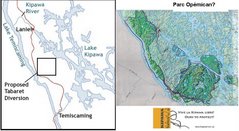
Kipawa, Tabaret, and Opemican

Kipawa, Tabaret, and Opemican
If Hydro Quebec is not actively pursuing Tabaret what is that bite out of Opemican for?

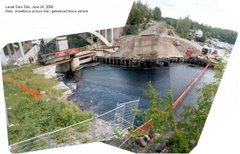
Kipawa Dam: After

Kipawa Dam: After
Laniel Dam at 2006 Rally

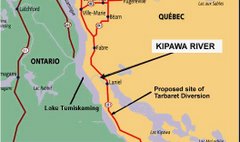
Where is the Kipawa

Where is the Kipawa
Kipawa flows into lake Temiskamingue, running from Kipawa Lake, under hwy 101 in Quebec

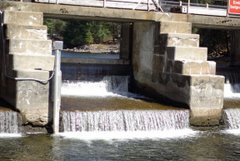
Kipawa Dam

Kipawa Dam
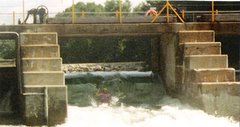
laniel dam at 2004 River Rally

Tabaret is a Bad Idea

About the Kipawa


The best thing paddlers can do to help the cause of the Kipawa:

1. attend the rally and bring others including non paddlers to attend and buy beer and have fun

2. write your MP /MNA and raise the issue and post your objections -1 letter = 200 who didn't write

3. Write Thierry Vandal the CEO of Hydro Quebec strongly opposing the 132 MW standard decrying the use of "diversion" as the most environmentally inappropriate method of power production

4. Write Jean Charest, Premier of Quebec protesting that either the algonquin or the tabaret project will eliminate all other values on the Kipawa River by turning it into a dry gulch.

5. See if you can get other allied groups interested by showing your own interest, ie the Sierra Defense Fund, Earthwild, MEC, and so on.

6. Demand further consultation
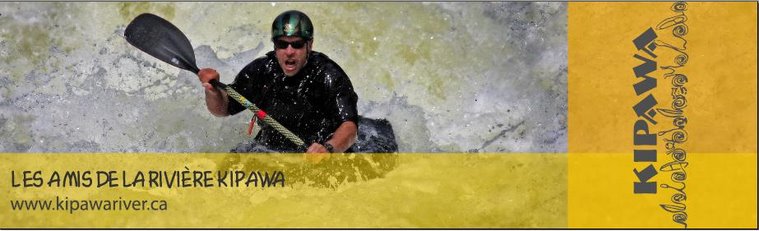
7. Currently we are at the point where we need to sway public opinion and raise awareness.

However, if all else fails, don't get mad, simply disrupt, foment, and protest . The Monkey Wrench Gang.

Have you read Edward Abbey?

Important Addresses
CEO,Hydro Québec, 75 boul René Levesque, Montreal, P.Q., H2Z 1A4Caille.andre@hydro.qc.ca


Tabaret is a Bad Idea (Part Two)

Les Amis de la Riviere Kipawa is poised to use an application to the Federal Court to issue a Writ of Mandamus to ensure the Minster does what he is supposed to do, protect the public's right to navigate the water control structure at Laniel, Quebec using the Navigable Waters Protection Act. (see http://www.kipawariver.ca/)
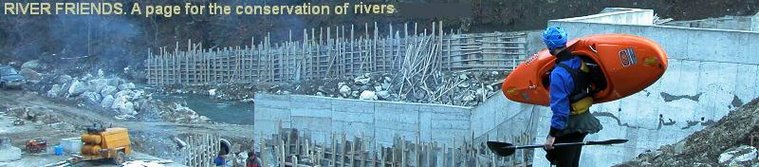
In the now gutted Navigable Waters Protection Act lay the means by which the Minister of Transport could keep the public right of passage down our great Canadian Heritage, our rivers and streams which are threatened especially by resource corporations and power brokers such as Hydro Quebec.

These powerful entities continue to petition that 'this' river or 'that' stream is not navigable and therefore not protectable.
I don't say that dams and bridges should not be built, only that if they are, historical navigation rights should be considered and preserved by making reasonable accommodations for recreational boaters.

It is the Minister of Transport, in exercising the right to allow or disallow work on or over a navigable waterway is what keeps boats and recreational boaters plying our waterways.

To many recent cases launched in the Federal Court concerning the Navigable Waters Protection Act, most recently the case of the Humber Environment Group of Cornerbrook Newfoundland versus the Cornerbrook Pulp and Paper Company indicates that the important oversight is not being faithfully performed. Have we really come to the point now where we must say "such and such a stream is one foot deep, possessing so many cubic feet per second flow and so on?" The answer to this is... YES!

The honourable Mr. Justice John A. O'Keefe, ruled that it had not been shown that the river was navigable. How convenient was that to the Minister? But either the Minister of Transport acts to protect our rivers and streams as a public right or he does not and that means rivers and streams currently enjoyed by kayakers and canoists.

Enough of the cheating, and double-talk. Canadians! our rivers and streams are our own, lets urge the Minister of Transport and the our government to protect them.

Peter Karwacki

Tabaret is a Bad Idea (Part Three)

10 Reasons WhyTabaret is a Bad Idea1) Tabaret is too big. The station is designed to useevery drop of water available in the Kipawawatershed, but will run at only 44 percent capacity.We believe the Tabaret station is designed to usewater diverted from the Dumoine River into theKipawa watershed in the future. 2) The Tabaret project will eliminate the aquaticecosystem of the Kipawa River.The Tabaret project plan involves the diversion of a16-km section of the Kipawa River from its naturalstreambed into a new man-made outflow from LakeKipawa. 3) Tabaret will leave a large industrial footprint on thelandscape that will impact existing tourismoperations and eliminate future tourism potential. 4) The Tabaret project is an aggressive single-purposedevelopment, designed to maximize powergeneration at the expense of all other uses. 5) River-diversion, such as the Tabaret project, takinglarge amounts of water out of a river’s naturalstreambed and moving it to another place, is verydestructive to the natural environment. 6) The Kipawa River has been designated a protectedgreenspace in the region with severe limitations ondevelopment. This designation recognizes theecological, historical and natural heritage value ofthe river and the importance of protecting it.Tabaret will eliminate that value. 7) If necessary, there are other, smarter and morereasonable options for producing hydro power onthe Kipawa watershed. It is possible to build a lowimpactgenerating station on the Kipawa river, andmanage it as a “run-of-the-river” station, makinguse of natural flows while maintaining other values,with minimal impact on the environment. 8) The Kipawa watershed is a rich natural resource forthe Temiscaming Region, resonably close to largeurban areas, with huge untapped potential fortourism and recreation development in the future.Tabaret will severely reduce this potential. 9) Tabaret provides zero long-term economic benefitfor the region through employment. The plan is forthe station to be completely automated andremotely operated. 10) The Kipawa River is 12,000 years old. The riverwas here thousands of years before any peoplecame to the region. The Tabaret project will change all that.

Problems on a local River?

  • There is more to do as well but you have to do your research and above all, don't give up.
  • IN the meantime prepared a document itemizing the history of navigation of this spot and its recreational value. Use the Kipawa river history of navigation as a guide: see www.kipawariver.ca
  • Under the Ministry of Environment guidelines you have a set period of time to petition the change under the environmental bill of rights, you may have limited time to take this action. But it involves going to court for a judicial review of the decision.
  • 4. contact the ministry of natural resources officials and do the same thing.
  • 3. contact the ministry of the environment and determine if they approved the project
  • 2. determine if the dam was a legal dam, approved under the navigable waters protection act.
  • 1. research the decision and timing of it to determine if an environmental assessment was done.

Minden Ontario

Minden Ontario
Gull River Water control at Horseshoe lake

A History of Navigation on the Kipawa River

Prior to the environmental assessment there was no signage at the Laniel Dam

T-Shirts Area: These are available now!

T-Shirts Area: These are available now!
Send $25 and a stamped self addressed envelop for the Tshirt, and for the bumper sticker, a stamped and self addressed envelope with $5.00 for the bumper sticker to Les Amis de la rivière Kipawa, 80 Ontario St., Ottawa, Ontario, K1K 1K9 or click the link To purchase a Les Amis "T" contact Doug with the following information: Number of shirts:Sizes: Ship to Address: Method of Payment: cash, cheque and paypal, Shipto address:

Bumper Stickers Now Available

Bumper Stickers Now Available
Get your bumper sticker and show your support for the Kipawa Legal Fund ! - send $5.00 in a Stamped, self addressed envelope to: Peter Karwacki Box 39111, Ottawa, Ontario, Canada, K1H 7X0