


Cumulative Impacts of Projects on the Kipawa River, Timiskaming, Québec: The Case for a Water Management Plan
Peter Karwacki, PMP
Abstract
The Kipawa River in Abitibi-Témiscamingue, Québec, was named one of the Seven Natural Wonders of Québec in 2007. Its flows are controlled by the Kipawa and Laniel dams, and its most significant human footprint is hydropower. This paper reviews the history of the Laniel Dam refurbishment, the flow regime observed below the dam, an unplanned high release that damaged downstream features, and the proposed Onimiki diversion and generating station. It argues that these projects must be assessed together, and that approval of any new diversion should be conditional on a Kipawa River Water Management Plan with a defined reserve flow, scheduled recreational releases, public reporting, and a formal role for river stakeholders.
1. Setting
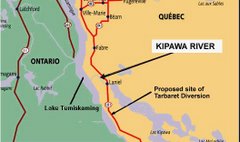
From Lake Dumoine, the Kipawa meanders over 300 km before discharging into the Ottawa (Outaouais) River. Its watershed of about 6,000 km² is mostly undeveloped land with many small lakes. A large zone d'exploitation contrôlée (ZEC) allows low-cost public fishing, hunting, harvesting and camping. A growing number of shoreline residences adds some pressure on riparian zones, but the largest human footprint in the watershed is hydropower. The river flows through Lake Kipawa, which is controlled by the Kipawa Dam and the recently refurbished Laniel Dam.
Below Laniel, the river has many named whitewater rapids and a 30 m waterfall, the Grande Chute, which appeared on the Canadian $10 note issued in 2017 for the 150th anniversary of Confederation. Opémican National Park, created as a protected area of 252.5 km², lies along the river. The Lake Kipawa reservoir holds about 3.5 billion m³. Named rapids include: Broken Bridge Rapid, Grande Chute, Hollywood Rapid, Laniel Dam, station 02JE015).
2. The Laniel Dam refurbishment and judicial review
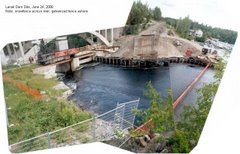
The refurbishment project involved two elements: an application to approve the old Laniel dam, which had never been approved under the Navigable Waters Protection Act, and the transfer of the renovated dam to the Province of Québec. In August 2006 the Minister of PWGSC announced that the dam would transfer to Québec once reconstruction was complete, anticipated for early 2010 [source: J. Charlebois, PWGSC].
The federal environmental assessment of the rebuild was challenged by judicial review brought by Les amis de la rivière Kipawa (Federal Court file T-452-06). The record shows the following sequence:
Officials first held that navigation of the dam was illegal, citing the Dam Safety Act. Les amis showed that the dam itself had never been approved.
Officials then held that navigation was unsafe. Les amis documented more than 40 years of safe navigation, including heavily attended whitewater festivals.
Officials then held that the loss of navigation rights was insignificant. The river's subsequent profile, including the creation of Opémican National Park and the Grande Chute's appearance on the $10 note, suggests otherwise.
The Court noted the mitigation measures that took Les amis' views into account: maintaining the existing management of the Kipawa reservoir waters after construction, keeping dam operating procedures unchanged, maintaining water levels during the navigation period between 269.75 m and 269.50 m, creating a safe pathway from the lake to the river, building a boat ramp, and providing a shuttle during construction. The decision is available from the Federal Court.
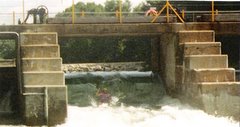
Before the 2005 refurbishment the dam leaked at its base at roughly 30 to 35 m³/s for many years, even with the stop logs closed [source: McGill storymap]. Les amis argue that this historical leakage represents the river's true reserve flow, and that 35 m³/s is therefore the minimum reserve requirement.
3. Observed flow regime
Three hydrometric stations operate on the river: 02JE029, 02JE001 and 02JE015. At station 02JE029, about 0.2 km downstream of Laniel, monthly average flows are highest in winter (December and January) and spring (May), with substantial year-to-year variability (Figure 1). Flows of 298 m³/s or more have been recorded. The data summarized here cover 1962 to 1969 and 2012 to 2022 [source: McGill Ecohydrological Systems Laboratory, 2024]. The limited sensitivity of this regime to climate or land cover change is likely due to dam operation.
The Kipawa also receives additional flows during the recreational paddling season. During the Kipawa River Rally weekends, flows reach 300 m³/s and above.
The Ottawa River Regulation Planning Board states that its aim is integrated management of the principal reservoirs of the Ottawa basin to reduce flood and drought impacts and to maintain beneficial water uses, including the Kipawa [source: ottawariver.ca].
4. Cumulative impacts
4.1 An unplanned release and its downstream effects
An unexpectedly large release from the refurbished Laniel Dam, made possible by the new dam's greater capacity, caused flooding and damage along the river. The release destroyed the access bridge of a logging company at Broken Bridge Rapid. The wreckage remained in the river for years until the bridge was replaced when Opémican Park was created. The scour also removed the eddies on either side of the bridge, a loss of recreational value, and requests to replace the lost boulders were not taken up by park officials.
Downstream, the same event moved a very large boulder from its position on the right bank of Hollywood Rapid, at the mouth of the Kipawa next to the Kipawa River Lodge, into the centre of the rapid. This permanently changed the character of the rapid and how it is navigated. In the author's observation the flow exceeded the metered 300 m³/s, but no record of the actual flow was kept
There is no evidence in the record that dam operators consulted anyone before the release or anticipated this damage. The question this raises is institutional: who is responsible for the effects of operating decisions on the riverbed and its users, and who speaks for the river when those decisions are made?
4.2 Opémican National Park and the proposed diversion
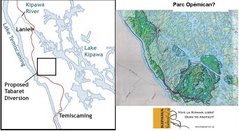
The river, Opémican National Park and its proposed biodiversity reserve are affected by proposals to divert water from the river. A diversion from Lake Kipawa to a new outlet and generating station was first proposed by Hydro-Québec as the Tabaret River Diversion Project. A similar proposal has been revived as the Onimiki project, which also draws on the Kipawa reservoir. Onimiki is described by its proponents as a community project led by the Kebaowek and Wolf Lake First Nations, the Pekuakamiulnuatsh Takuhikan, and the MRC de Témiscamingue. Its output, expected to be 42 MW, would be sold to Hydro-Québec. The author and Les amis regard it as a continuation of the Tabaret proposal.
The diversion would send a large share of the river's flow, potentially 70 to 80 percent during some periods, through a tunnel of about 2.9 km, reducing flows in the natural channel just upstream of Opémican National Park. Fondation Rivières and the Organisme de bassin versant du Témiscamingue are concerned about the effect on the Grande Chute, a landmark and tourism draw for the park. Continuity of flow also supports nutrient transport, soil moisture for forest growth, and links between fish and insect habitats. The project was revised in January 2025 so that all infrastructure, including the underground pipe, lies outside the park boundary. It remains linked to the park because it draws on the same water system.
4.3 The reserve flow
The Onimiki proponents propose a reserve flow of 15 m³/s. This is less than half the 30 to 35 m³/s that leaked through the old dam for decades. Les amis argue that the foreseeable cumulative effect would be a largely dewatered river channel, an outcome they predicted during the Federal Court proceedings.
5. Regulatory status
Onimiki Renewable Energy filed its project notice with the Québec Ministry of the Environment, Climate Change, Wildlife and Parks (MELCCFP) in June 2024. The ministry issued a directive for the environmental impact assessment, and identifying cumulative effects is one of its required elements [source: registry file 3211-12-265]. The proponents' regional study area is intended to cover all potential impacts. Once the proponents submit the study and it is deemed admissible, the BAPE would be mandated to hold public consultations. At the time of writing the BAPE is not yet involved. A federal Impact Assessment Panel is also referenced.
6. A Kipawa River Water Management Plan
Les amis de la rivière Kipawa request a water management plan that includes:
A schedule of recreational releases, including summer weekends.
A reserve flow of 35 m³/s and an agreed new maximum flow.
A recognized role for Les amis in future decisions about releases.
When not releasing for recreation, water could be used for run-of-river generation at Laniel rather than through a new outflow away from the river. Les amis propose releases of about 6.5 hours per day at about 30 m³/s on Monday to Thursday (9:30 to 16:00), in addition to the statutory weekends, particularly for the Kipawa River Rally.
A seasonal schedule has also been suggested: weekends in April, May, September and October, Thursday to Monday in June, July and August, and possibly the last weekend in March. The existing stop log configuration on the southernmost gate at Laniel could be modified to provide a whitewater play park and a run-of-river power diversion without impeding generation. This builds on the author's earlier CDA presentation on navigation of water control structures.
6.1 Precedents
The Madawaska River Water Management Plan in Ontario was developed by Ontario Power Generation with the Ministry of Natural Resources and Forestry, local stakeholders and organizations including the Madawaska Kanu Centre. Established in 2009 and reviewed periodically, it sets enforceable provisions for water levels and flows, balancing generation with conservation, flood control and recreation, including scheduled flows for whitewater paddling [verify].
The Ocoee River release agreements in Tennessee, managed by the Tennessee Valley Authority, guarantee scheduled releases for whitewater rafting and boating through contracts with outfitters, extended for periods of up to 15 years. The Ocoee was among the first federal projects to give priority to downstream recreation and shows that generation and a recreation economy can coexist.
6.2 Recommended conditions
Approval of any new diversion should be conditional on a Water Management Plan that includes:
Minimum environmental flow requirements to protect aquatic habitat and biodiversity.
Scheduled recreational releases in peak seasons, informed by stakeholder consultation.
Ongoing monitoring and adaptive management, with public reporting and review.
Collaboration with affected First Nations, park authorities and recreational organizations, similar to the working group already proposed by Onimiki Renewable Energy.
7. Conclusions
The Laniel Dam refurbishment began as a repair project and has produced a series of consequences that were raised in court but not resolved in operation: an unplanned release with lasting downstream effects, a contested reserve flow, and a proposed diversion that would draw heavily on the same river. The Kipawa shows why proponents should consult stakeholders early and often. A water management plan would reduce operational uncertainty and protect the river's ecological and recreational values. Run-of-river configurations are the option most compatible with protecting whitewater resources.
References
Federal Court, Les amis de la rivière Kipawa judicial review, T-452-06.
McGill Ecohydrological Systems Laboratory (2024). Kipawa River storymap (S. Newell-Macintosh, March 6, 2025). arcgis.mcgill.ca.
Onimiki Renewable Energy project documents, including the 2025 regional study area presentation. onimiki.ca.
MELCCFP, environmental assessment registry, file 3211-12-265.
Ottawa River Regulation Planning Board. ottawariver.ca.
Les amis de la rivière Kipawa, threats and court discovery archive.
Statistics: Institut de la statistique du Québec regional bulletin, .

























No comments:
Post a Comment